- This topic is empty.
-
AuthorPosts
-
2026-10-21 at 5:23 pm #12326
VivaChek Glucose and Ketone System: One Strip, Two Results
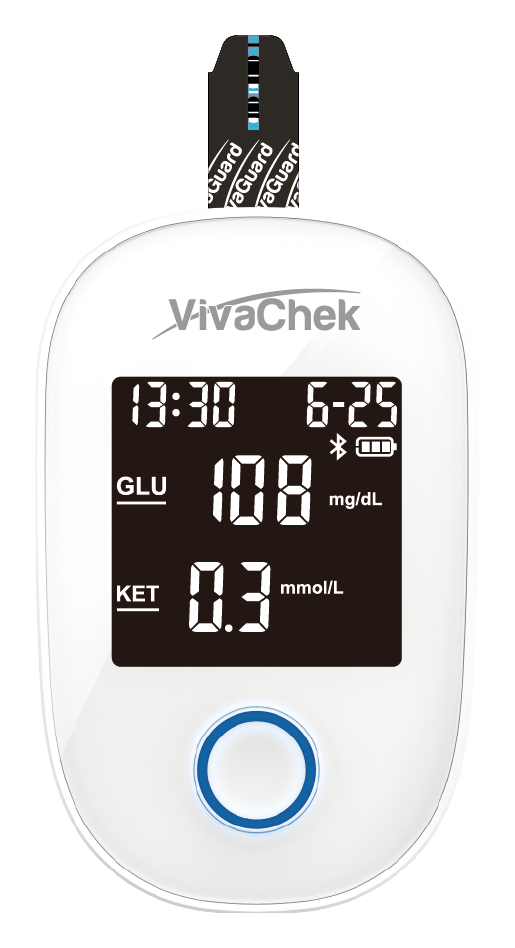
Blood glucose and β-ketone monitoring have traditionally been treated as two separate jobs. The VivaChek Blood Glucose and β-Ketone Dual System, developed by Weice Biotech under the VivaChek brand, revisits that assumption. It is a point-of-care meter built around a single test strip that reports both blood glucose and β-ketone from one fingerstick, with an auto-coding design and an optional Bluetooth Low Energy connection to the VivaChek GlucoKet App.
The Problem the System Addresses
Separate glucose and ketone testing multiplies the supplies a user has to buy, the steps they have to perform, and the cost of routine monitoring. Three further frictions recur in this category: manual coding, which can introduce result errors; larger sample volumes, which can make routine testing less comfortable; and limited data connectivity, which can reduce convenience for self-monitoring.
Weice Biotech’s stated positioning is a direct response to that combination — a one-meter, one-strip dual testing system for blood glucose and β-ketone, with auto coding and optional Bluetooth data management. The value proposition follows the same logic: simplify metabolic monitoring by delivering glucose and ketone results from one fingerstick, with fewer supplies, fewer steps, and faster feedback.
How Dual Measurement Works
Electrochemical biosensor with two enzyme systems. The VivaChek platform is an electrochemical biosensor. Glucose is read using glucose dehydrogenase, and β-ketone is read using β-hydroxybutyrate dehydrogenase. Both measurements are carried on the same strip architecture, which is what allows a single sample to serve two analytes.
Auto coding. The meter automatically identifies and reads the coding information of each test strip, which lowers the risk of coding error compared with manual entry.
Sample handling. The sample type is fresh capillary whole blood drawn from the fingertip — a standard point-of-care sample. Application uses wicking action with an end-fill design, so the strip draws the blood it needs rather than requiring the user to aim a drop precisely.
Calibration and units. Results are calibrated to plasma-equivalent values, which aligns the reading with plasma values and supports clinical interpretation. Glucose is reported in mg/dL, consistent with standard US glucose reporting; β-ketone is reported in mmol/L, the standard ketone unit.
Technical Specifications
These figures come from the manufacturer’s published specifications for the VivaChek Blood Glucose and β-Ketone Dual System.
- Glucose measurement range: 20–600 mg/dL, covering low to high glucose values
- β-ketone measurement range: 0.1–8.0 mmol/L, supporting normal through severe ketosis monitoring
- Sample size: about 1.6 microliters
- Testing time: about 12 seconds
- Hematocrit range: 20–65%
- Operating temperature: 45.5°F–113°F (7.5°C–45°C)
- Operating humidity: 10–90% R.H., non-condensing
- Test strip storage temperature: 36°F–86°F (2°C–30°C)
- Test strip shelf life: 24 months unopened, 6 months after opening
- Battery: rechargeable 250 mAh, 3.7 Volt DC nominal lithium polymer, 5V input charge voltage, charged through a USB Type-C port
- Automatic shutoff: 120 seconds after the last action
- Backlight: yes; beep function: yes; hypo warning: yes
- Bluetooth: optional, version 5.1
- Test averaging, strip ejector, ketone warning, meal markers, and test alarms: not included
Analytical Performance
Accuracy claims matter only when they are traceable, so it is worth stating what the source material reports rather than paraphrasing it loosely. Meter results clustered along the fitted regression line with strong linearity, an R² greater than 0.96, a slope of approximately 1, and no obvious bias. Glucose results showed good agreement with the comparator, with R² = 0.97 and a slope of approximately 1. β-ketone results showed a good linear fit, with R² = 0.996, a slope of approximately 1, and an intercept of approximately 0.
In plain terms, a slope near 1 and an intercept near 0 indicate that the meter’s readings track the reference method across the measured range rather than drifting at the low or high end.
Data, Connectivity, and Daily Use
The meter stores 300 records with date and time, which supports self-monitoring history without requiring a paper log. Where the Bluetooth option is specified, the meter connects to the VivaChek GlucoKet App for data transfer. The absence of test averaging, meal markers, and test alarms is worth noting for users who rely on those features; this system concentrates on measurement, storage, and transfer instead.
The hematocrit range of 20–65% reduces the effect of hematocrit on test results and broadens usability across more users. Charging through USB Type-C means the meter does not depend on disposable batteries, and the 120-second automatic shutoff conserves battery between sessions.
Reading Results: Reference Ranges
The source material includes interpretation guidance rather than leaving users to interpret numbers alone.
Fasting glucose: normal below 100 mg/dL; prediabetes 100–125 mg/dL; high at or above 126 mg/dL; low below 70 mg/dL.
β-ketone: normal below 0.6 mmol/L; mild elevation 0.6–1.5 mmol/L; moderate ketosis 1.5–3.0 mmol/L; severe ketosis above 3.0 mmol/L.
These bands are presented with reference to the American Diabetes Association, Standards of Care in Diabetes—2023, and the International Society for Pediatric and Adolescent Diabetes, Clinical Practice Consensus Guidelines: Diabetic Ketoacidosis and Hyperglycemic Hyperosmolar State.
Who the System Fits
The customer type is individuals monitoring blood glucose and β-ketone levels — people managing diabetes, metabolic health, or ketosis risk, and particularly those who need fasting glucose and ketone tracking in the same routine. The delivery model is a hardware meter with disposable test strips, plus an optional Bluetooth Low Energy connection to a companion app. Only one product sits in this line: the VivaChek Blood Glucose and β-Ketone Dual System itself.
Why the Dual Design Matters
The differentiated case for the VivaChek system rests on four measurable things: one strip measuring both analytes, removing the need for separate strips or meters; auto coding that reads each strip’s calibration automatically; a 12-second test time from a sample of about 1.6 microliters; and a 20–65% hematocrit range that keeps readings usable for a wider set of users. Optional Bluetooth 5.1 and USB Type-C charging round out the platform.
For buyers weighing a dual-monitoring meter, the practical question is whether one device can carry both measurements without a second set of consumables or a second workflow. Weice Biotech has built the VivaChek system to answer that question with one strip, one sample, and two results.
https://www.vivachek.com/
VivaChek Biotech (Hangzhou) Co., Ltd. -
AuthorPosts

- You must be logged in to reply to this topic.