- This topic is empty.
-
AuthorPosts
-
2026-10-23 at 2:36 pm #12377
In a busy commercial kitchen, every workstation affects how efficiently staff prepare ingredients, assemble dishes, and organize supplies. Poorly planned work surfaces can lead to unnecessary movement, uncomfortable working positions, cluttered preparation areas, and time-consuming cleaning routines.
Choosing the right commercial kitchen work table helps address these everyday challenges. The table should provide enough working space, remain stable during use, offer practical storage where needed, and fit naturally into the kitchen layout. For facilities with multiple employees and changing preparation tasks, ergonomic considerations are particularly important.
However, not all adjustable work tables serve the same purpose. Understanding the differences between height-adjustable surfaces and adjustable leveling feet is a useful starting point when selecting equipment for restaurants, hotels, catering businesses, and institutional kitchens.
1. Why Ergonomics Matters in Commercial Kitchen Design
Kitchen staff often spend hours standing while cutting vegetables, preparing ingredients, portioning food, and assembling orders. Repeated bending, twisting, reaching, and lifting can make these tasks more physically demanding, especially during peak service periods.
The height and arrangement of a workstation influence how employees perform these activities. A work surface that is too low may encourage forward bending, while one that is too high can force employees to raise their shoulders or adopt uncomfortable arm positions.
An ergonomic workstation should match the task being performed and allow frequently used tools and ingredients to remain within a comfortable reach. Adequate clearance around the table is equally important because staff need room to turn, move containers, and transport food safely.
When planning a commercial kitchen, operators should evaluate work tables as part of the overall workflow rather than selecting them based on dimensions or appearance alone.
2. Understand the Difference Between Adjustable Table Designs
The term “adjustable work table” can describe different features. Buyers should identify the intended function before comparing products.
Height-adjustable work surfaces
A height-adjustable table allows the tabletop itself to move up or down. This design can be useful when employees of different heights share a workstation or when the same surface is used for different preparation activities.
Before choosing this type of table, check the adjustment range, load capacity, stability, and ease of operation. The adjustment mechanism should also be suitable for the kitchen environment and the frequency of changes required.
Tables with adjustable leveling feet
Adjustable feet are designed primarily to compensate for minor floor irregularities and help keep the table level. They do not necessarily change the working height of the tabletop for ergonomic purposes.
A level, stable surface is important when staff are cutting ingredients, arranging trays, or handling containers. If the table rocks during normal use, employees may find routine tasks less comfortable and equipment placed on the surface may become less secure.
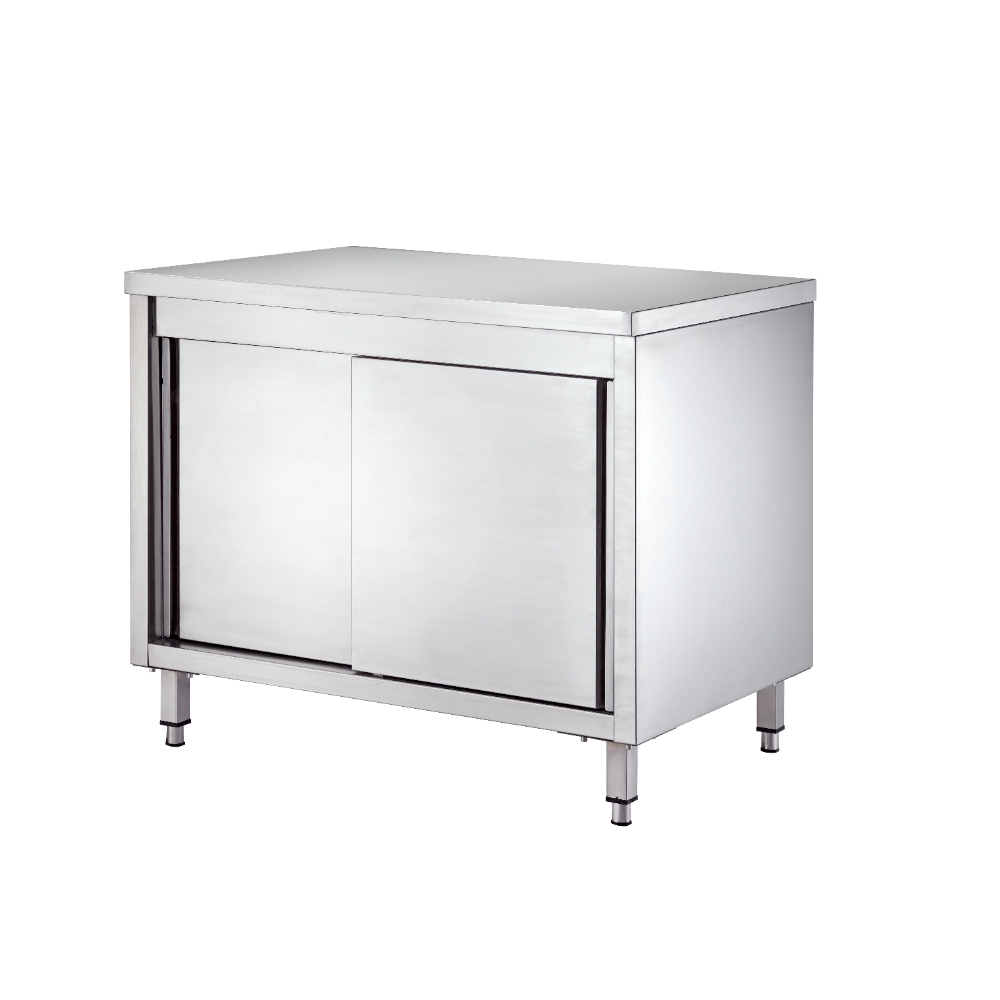
For example, HIYOO's stainless steel sliding door work table cabinet includes height-adjustable feet for leveling. Buyers who specifically need a tabletop that moves between working heights should confirm that the selected product has that separate capability.
3. Plan the Workstation Around Daily Tasks
The most effective work table is one that supports the activities performed at that location. A preparation station, plating area, and packaging workstation may have different space and storage requirements.
A vegetable preparation station may need room for cutting boards, ingredient containers, and waste collection. A plating station may require space for finished dishes, garnishes, and serving utensils. A packaging station may need a clear surface and convenient access to wrapping materials.
When assessing a work table, consider the following factors:
-
Working area: Ensure the tabletop accommodates the tools and containers required for the task.
-
Reach distance: Position frequently used items where employees can access them without repeated stretching.
-
Aisle clearance: Avoid selecting a table that obstructs staff movement or equipment access.
-
Equipment placement: Allow enough room for nearby appliances without overcrowding the work surface.
-
Cleaning access: Make sure staff can clean the tabletop, cabinet, legs, and surrounding floor.
A well-planned workstation reduces unnecessary movement and makes it easier for employees to maintain an organized preparation process during busy periods.
4. Use Storage to Keep the Work Surface Organized
Storage is an important consideration when selecting a commercial kitchen work table. Without a suitable place for utensils, containers, and supplies, employees may leave too many items on the tabletop, reducing the space available for food preparation.
An enclosed cabinet can provide storage while keeping selected items out of the main working area. Sliding doors are particularly useful in kitchens where aisle space is limited because they do not require the additional forward clearance associated with conventional hinged doors.
HIYOO offers a stainless steel sliding door work table cabinet with double-walled sliding doors and a worktop without a backsplash. The listed worktop depth options are 600 mm and 700 mm, allowing buyers to assess which configuration better suits their available space and preparation requirements.
The enclosed cabinet can help organize appropriate kitchen supplies, while the sliding-door design supports access in relatively compact layouts. For best results, store frequently used items in convenient locations and avoid placing heavy containers where employees must repeatedly bend deeply or reach overhead.
Storage arrangements should also reflect hygiene procedures. Items used for different tasks should be organized to prevent unnecessary handling and keep the primary work surface clear.
5. Choose the Right Table Dimensions
Table dimensions influence both usable workspace and movement around the workstation. A deeper table may accommodate larger containers and preparation equipment, but it can also reduce aisle clearance in a compact kitchen.
A 600 mm-deep worktop may suit installations where floor space is limited. A 700 mm-deep option may provide more room for larger preparation tasks, depending on the equipment and containers involved.
Before ordering, measure the installation area and consider how employees will approach the table, stand at the work surface, and move around nearby equipment. Also account for doors, drawers, refrigerators, and other fixtures that may affect access.
A worktop without a backsplash may be suitable for certain island arrangements or layouts where an open rear edge is preferred. If the table will be installed against a wall, however, operators should consider splash protection and how the surrounding surfaces will be cleaned.
The best configuration is determined by the actual workflow, not simply by choosing the largest available tabletop.
6. Stability and Noise Control Support Daily Operations
Commercial kitchen work tables must remain stable under their intended working loads. Uneven floors, incorrectly adjusted feet, or damaged components can cause rocking and interfere with routine tasks.
During installation, check that the table sits level and that its feet maintain appropriate contact with the floor. Confirm the manufacturer's load limits and avoid concentrating excessive weight on unsupported areas.
Rubberized feet may help reduce direct contact noise between the table and the floor, although the result depends on the flooring material, table loading, and operating conditions. They may also help protect suitable floor finishes from direct contact, subject to the design and installation requirements.
HIYOO's sliding-door work table cabinet incorporates adjustable feet and rubberized foot components. These features address practical leveling and floor-contact considerations, making them worth reviewing when assessing the table for a particular kitchen.
Routine inspections can help identify loose feet, worn contact components, or changes in stability before they disrupt daily operations.
7. Consider Materials, Cleaning, and Maintenance
A commercial kitchen work table must withstand frequent cleaning and exposure to food residues, moisture, and routine workplace activity. Stainless steel is commonly used for commercial kitchen equipment because it offers a practical, cleanable surface when properly specified and maintained.
However, buyers should verify the exact stainless steel grade, surface finish, construction details, and cleaning compatibility rather than assume that all stainless steel products have identical properties.
Maintenance requirements should also be considered before purchase. A table with accessible surfaces and practical construction details can simplify routine cleaning. For cabinet models, sliding-door tracks and interior surfaces should be included in the cleaning schedule because grease, crumbs, and debris may accumulate in these areas.
Recommended maintenance practices include:
-
Removing food residues promptly after use.
-
Following the manufacturer's instructions for cleaning agents.
-
Avoiding abrasive tools or chemicals that may damage the finish.
-
Inspecting adjustable feet and other moving components.
-
Checking door movement, visible joints, and signs of corrosion.
-
Addressing loose hardware or instability as soon as it is identified.
A straightforward maintenance routine helps preserve usability and reduces the likelihood of minor equipment problems becoming operational disruptions.
8. A Practical Checklist for Equipment Buyers
Before selecting a commercial kitchen work table, buyers should compare the product's features with the requirements of the intended workstation.
Key questions include:
-
Does the table provide enough surface area for the planned tasks?
-
Is tabletop height adjustment required, or are leveling feet sufficient?
-
Will the table fit without restricting staff movement?
-
Can enclosed storage help reduce countertop clutter?
-
Is the table stable under the expected working load?
-
Are the material specifications appropriate for the kitchen's cleaning procedures?
-
Can staff access the table and cabinet easily during routine cleaning?
-
Are maintenance requirements and replacement components clearly documented?
It can also be helpful to observe the existing workflow before purchasing new equipment. Identify where employees repeatedly move supplies, reach across the workstation, or encounter congestion. These observations provide a practical basis for deciding which table dimensions and features will be most useful.
Conclusion
Selecting a commercial kitchen work table involves more than choosing a durable surface. Ergonomics, dimensions, storage, stability, cleaning access, and the surrounding layout all influence how effectively employees can use the workstation.
Height-adjustable tables can accommodate different working positions, while adjustable feet help level equipment on uneven floors. Enclosed storage and sliding doors can also improve space utilization when the table is selected for the right application.
HIYOO's stainless steel sliding door work table cabinet combines a practical work surface, enclosed storage, and adjustable leveling feet for commercial kitchen environments. By checking the product dimensions, material specifications, load capacity, and installation requirements against actual operating needs, buyers can make a more informed equipment decision and create a more organized, functional kitchen workspace.
-
-
AuthorPosts

- You must be logged in to reply to this topic.