- This topic is empty.
-
AuthorPosts
-
2026-11-13 at 5:39 pm #13197
If your design review keeps circling what watt density should a battery PTC heating film use, the defensible answer is 0.2-0.6 W/cm² against the cell face and 0.5-1.0 W/cm² on a baseplate — with 0.6 W/cm² as the ceiling most cell makers will sign off. Push past roughly 1.5 W/cm² and the BMS reads a cell-surface overtemperature and aborts the preheat, which is the exact failure the heater was installed to prevent. This spec sheet from YOTTECH, the export brand of Jiangsu Yottuo New Materials Co., Ltd., a China manufacturer of carbon-based PTC heating film, gives the numbers behind those bands, the sizing formula and the acceptance data to request from a supplier.
The PTC heating film watt density 0.6 W/cm2 safety threshold is not a marketing figure. It falls out of the 40-45 °C maximum surface temperature LFP cells tolerate during preheat, plus the ≤5 °C spread a thermal camera should show across one module. Below, we work through the two numbers that actually decide a purchase: heat demand and cold resistance.
Published: November 13, 2026 | By YOTTECH Engineering Team
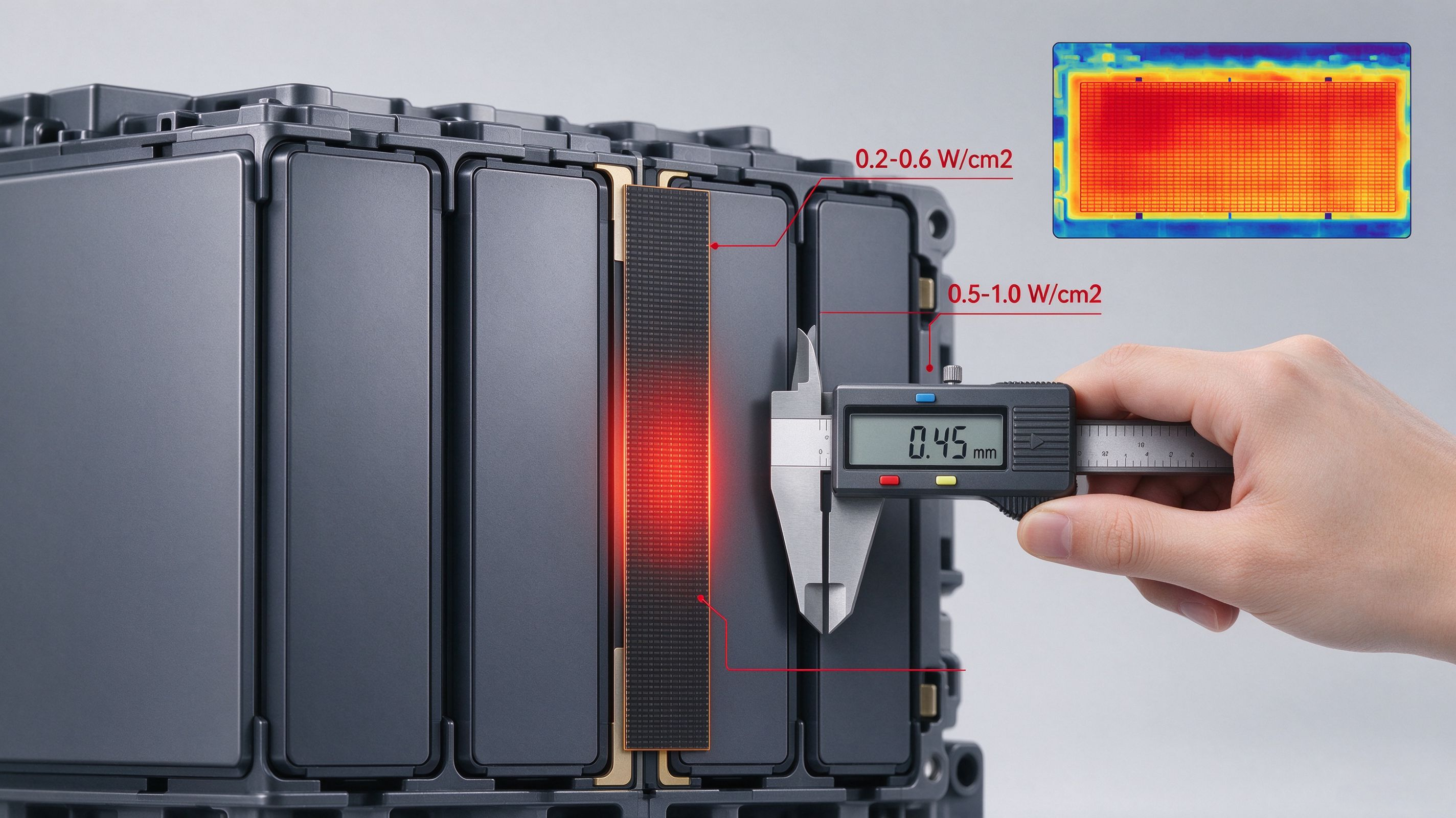
1. Where does the 0.6 W/cm² limit come from, and what happens above it?
It comes from the cell, not the heater: LFP cells should not see more than 40-45 °C on their surface during preheat, so local flux has to stay low enough that no spot ever reaches that ceiling. Heat flows from the film through the adhesive, the cell can and the electrolyte, and each layer adds thermal resistance. A film rated at 1.2 W/cm² in free air can still be safe at 0.4 W/cm² on a cell stack — or dangerous, depending on how well it is bonded. That is why a wattage number without a mounting description is close to meaningless.
Published engineering data puts the usable bands here:
✅ Cell-face heating: 0.2-0.6 W/cm²; interlayer contact gives the fastest warm-up but the smallest allowed flux.
✅ Baseplate or cold-plate heating: 0.5-1.0 W/cm²; the aluminium spreads heat, so a higher flux is tolerable.
✅ Above 1.5 W/cm²: hot spots trip BMS protection and preheat stops before the pack is ready.
✅ Reference points in the field: 0.3 W/cm² at -40 °C with a 70 °C ceiling and ±20% resistance tolerance (Backer HTI); <1.2 W/cm², 0.22±0.05 mm, -40 to 80 °C (BatteryRing); a typical 50 °C Curie point, 3.7-230 V, 0.1-0.4 mm and 10,000 h life (XHC).
These are published industry figures, not a single universal rating. The PTC heating film watt density 0.6 W/cm2 safety threshold should be re-verified against your own cell datasheet, because a 0.3 W/cm² film on a poorly bonded tray can create a hotter cell than a 0.6 W/cm² film pressed uniformly against it. Thermal imaging at full cold-start current, with at least three sensors on the module, is the cheapest way to prove it. YOTTECH builds its battery line at 0.5 mm so the film conforms to the cell block without an air gap; see the battery PTC heating film range for the shapes that suit interlayer mounting.
Scale matters too. A 60 kWh passenger-car pack needs roughly 5-9 kW in a cell-face architecture and 9-18 kW through a baseplate, yet a single cold start consumes only 0.3-0.7 kWh because the heating window is short. The question what watt density should a battery PTC heating film use therefore has a different answer for a 60 kWh pack than for a 2.5 kWh module: the total wattage scales with mass, while the per-area flux stays inside the same narrow band.
✅ Bottom line: Size for cell-surface temperature first — 0.2-0.6 W/cm² on cells, 0.5-1.0 W/cm² on a baseplate, never 1.5 W/cm².
2. How do you convert that watt density into a film size and resistance?
Start with the heat the cells must absorb and your allowed preheat window, then work backwards to area, resistance and cold-start current. The chain is short: Preq ≈ Cp·ΔT/t, then Rfilm = V²/Preq, then PD = Preq/Afilm. If PD lands outside the band above, you do not change the chemistry — you add film area, improve insulation, or extend the preheat window.
How to size PTC heating film wattage for a battery module becomes concrete with a real example. Lifting a 2.5 kWh module from -20 °C to +10 °C takes about 125 Wh of pure heat; with enclosure and wiring losses, budget 160-200 Wh. A 120 W film delivers that in 80-100 minutes. If the dock only allows a 30-minute window, the same module needs roughly 350-400 W — which forces you to spread the film over more cell faces rather than raising the flux on one.
✅ Low-voltage packs: 48 V / 100 Ah cold-storage AGV → 100-150 W; 51.2 V at 40 / 60 / 100 Ah → 100 / 150 / 200-300 W.
✅ Resistance: R = V²/P. A 150 W film on 48 V is about 15.4 Ω; a 100 W film on an 800 V platform is about 6.4 kΩ.
✅ Cold-start current: a carbon-based PTC film draws its highest current at the coldest temperature. Size the relay, fuse and harness from the -40 °C resistance, not the nominal 25 °C value.
✅ Batch spread: ask for the R-T curve of the actual production lot. A ±20% resistance tolerance changes both warm-up time and inrush.
How to size PTC heating film wattage for a battery module also depends on geometry that no formula captures: terminal position, notch cut-outs around busbars, and whether the film sits between cells or under the tray. YOTTECH engineers start from the tray drawing and return a die-cut layout with the resistance matched to the pack voltage — the same workflow used for the flexible PTC battery heating film for energy storage systems. For an OEM program, request a sample plan with the batch R-T report, dielectric withstand results and thermal images before releasing tooling.
One more check that is routinely skipped: Jiangsu Yottuo New Materials Co., Ltd. recommends logging film surface temperature and cell temperature separately during the first cold start. A 5-8 °C lag between the two is normal, and a BMS that switches off on film temperature alone will stop the preheat while the cells are still below 0 °C. That single calibration error looks exactly like an undersized heater.
✅ Bottom line: Compute Preq from pack mass and ΔT, divide by available area, then verify cold resistance before releasing the order.
Frequently Asked Questions
Q: What watt density should a battery PTC heating film use on a 48 V / 100 Ah AGV pack?
A: Stay at 0.2-0.6 W/cm² on the cells and size total output to 100-150 W. That is enough to lift a cold pack into its charging window inside one opportunity-charge cycle without driving a cell surface past 45 °C.
Q: Does a self-limiting film still need a controller?
A: Yes. Self-limiting caps the film's own temperature, but the BMS still has to decide when to start heating, when to allow charging, and what to do if a relay sticks. Keep the relay, fuse and at least three cell sensors in the loop.
Q: Do you supply custom films with batch R-T data for OEM programs?
A: Yes. YOTTECH supplies OEM/ODM custom heating films with lot-specific R-T curves, sample validation and wholesale tiers from its factory in Xinyi, Jiangsu. The plant covers 5,000 m² with an annual capacity above 1 million m² and holds CQC certification for electric heating film. For automotive programs, ask your supplier to evidence the additional automotive and safety approvals your customer requires rather than assuming they are already in place.
Get a Sized Film Layout in One Working Day
Send YOTTECH your pack voltage, cell-face area, coldest design ambient and allowed preheat time. Our engineers will return a die-cut layout, the Preq calculation, a cold-resistance check and an OEM sample plan from our China factory — free, within one working day. YOTTECH also quotes factory-direct pricing for volume programs.
http://www.yotthermo.com
Jiangsu Yottuo New Materials Co., Ltd. -
AuthorPosts

- You must be logged in to reply to this topic.