- This topic is empty.
-
AuthorPosts
-
2026-06-25 at 10:24 pm #8934
Section 1: Industry Background + Problem Introduction
The global expansion of fiber-to-the-home (FTTH) networks, broadband infrastructure, and telecom access systems has created unprecedented demand for reliable customer premises equipment. Internet Service Providers (ISPs), telecom operators, and broadband companies now face a critical operational challenge: maintaining continuous connectivity for subscriber-side devices—routers, optical network terminals (ONTs), gateways, and customer premises equipment (CPE)—during power interruptions, voltage fluctuations, and grid instability.
Power-related equipment reboots generate cascading consequences across network operations. Each interruption triggers service complaints, increases remote troubleshooting workload, escalates field maintenance costs, and damages customer satisfaction metrics. In regions with unstable power infrastructure, repeated device restarts can undermine the entire value proposition of high-speed broadband services. Traditional AC uninterruptible power supply (UPS) systems offer protection but introduce deployment complexity, space constraints, cost barriers, and compatibility mismatches at the customer premises level.
The industry urgently requires compact DC backup power solutions specifically engineered for subscriber-side equipment—solutions that address voltage matching, current capacity, connector compatibility, backup runtime requirements, and installation constraints. Shanghai Mylion New Energy Co., Ltd. (MYLION), with over 13 years of specialized experience in Mini DC UPS and telecom battery backup unit (BBU) development, has established technical leadership in this domain through engineering-driven product design, project-based application matching, and comprehensive support for international B2B deployment scenarios across telecom, ISP, broadband, and network infrastructure applications.
Section 2: Authoritative Analysis – Technical Compatibility Framework for DC Backup Power
Ensuring compatibility between DC backup power units and target network devices requires systematic evaluation across multiple technical dimensions. MYLION’s engineering approach centers on application-specific matching rather than generic product supply, addressing critical compatibility factors that determine deployment success or failure.
Voltage Matching and Output Stability: Network devices operate at diverse DC voltage levels—5V, 9V, 12V, 15V, 24V, and 48V—depending on equipment type and manufacturer specifications. MYLION’s product portfolio, including the MU68, MU26, MU48 standard 12V Mini DC UPS series and the MU248 for 24V/48V applications, provides voltage-specific solutions. Voltage compatibility extends beyond nominal output: stable voltage regulation under varying load conditions and during battery discharge cycles prevents device malfunctions, unexpected reboots, or component damage during backup operation.
Current Capacity and Surge Current Handling: Device compatibility failures frequently stem from inadequate current capacity analysis. While power adapter labels provide rated current specifications, real-world operating current—particularly during device startup surge conditions—often exceeds nominal ratings. MYLION addresses this through high-current models such as MU35 and MU65 designed for advanced gateways, higher-power routers, WiFi gateways, and broadband CPE requiring stronger output capability. The engineering process emphasizes pre-deployment evaluation of actual working current, peak current during boot sequences, adapter rating verification, load behavior analysis, and safety margin calculation to prevent under-specification that causes shutdown or restart during customer testing.
Connector and Cable Interface Compatibility: Physical connection compatibility represents a fundamental yet frequently overlooked deployment barrier. Network equipment utilizes diverse connector types—DC barrel connectors with varying outer/inner diameter specifications, proprietary connector designs, and increasingly, USB-C Power Delivery (PD) interfaces. MYLION’s MUC85 USB-C PD Mini UPS series addresses the emerging requirement for modern device architectures adopting USB-C power input, eliminating conversion complexity. For traditional DC applications, MYLION supports project-based connector customization, cable length adjustment, and interface matching to ensure seamless integration with target equipment without adapter modifications or connection reliability concerns.
Backup Runtime Calculation and Battery Capacity Matching: Runtime requirements depend on deployment scenarios: brief outage bridging in relatively stable grids versus extended backup in regions with frequent or prolonged power interruptions. Accurate runtime estimation requires battery capacity calculation based on device power consumption (voltage × actual operating current), discharge efficiency factors, battery management system (BMS) protection thresholds, and environmental temperature considerations. MYLION’s engineering support includes runtime target confirmation, capacity selection guidance, and realistic expectation setting based on measured device load rather than theoretical maximum specifications.
Installation Space and Deployment Form Factor: Customer premises installations impose strict spatial constraints. MYLION’s MUJ46 inline FTTH Mini UPS series exemplifies space-optimized design for fiber broadband, ONT, router, and gateway backup applications where installation space near fiber terminal boxes or customer equipment locations is extremely limited. The inline DC backup architecture connects between the original power adapter and device, enabling clean, unobtrusive deployment suitable for residential broadband and small office environments where bulky equipment is impractical or aesthetically unacceptable.
Protection Circuit and Safety Compliance: Compatibility extends to safety requirements and protection mechanisms. MYLION Mini DC UPS and BBU products incorporate BMS protection against overcharge, over-discharge, overcurrent, short circuit, and abnormal operating conditions. International B2B projects require compliance documentation—CE, FCC, RoHS, UN38.3, MSDS, and IEC 62368-related evaluation—depending on target markets and specific model configurations. MYLION supports certification coordination, technical documentation provision, and lithium battery transport compliance for qualified international shipments.
Section 3: Deep Insights – Evolution Trends in Subscriber-Side Backup Power
Several convergent trends are reshaping compatibility requirements and technical specifications for DC backup power in telecom and ISP applications, driven by network infrastructure evolution, device power architecture changes, and operational model transformation.
Power Architecture Transition to USB-C PD: Network equipment manufacturers are progressively adopting USB-C Power Delivery standards, moving away from proprietary DC barrel connectors. This transition improves user experience through universal charging compatibility but creates new backup power compatibility challenges. Traditional 12V DC UPS products cannot directly support USB-C PD devices due to different voltage negotiation protocols, power delivery profiles, and connector specifications. MYLION’s investment in USB-C PD backup power solutions positions ISPs and equipment suppliers to address next-generation device backup requirements as the installed base transitions toward modern power architectures.
Increasing Device Power Consumption: Advanced routers, WiFi 6/WiFi 7 gateways, multi-gigabit ONTs, and integrated CPE devices exhibit rising power consumption compared to earlier-generation equipment. Higher processing capability, additional radio interfaces, expanded port configurations, and integrated functions drive increased current draw. This trend necessitates backup power solutions with higher current capacity, larger battery systems, and robust thermal management—moving beyond low-power Mini UPS products toward high-current BBU specifications represented by MYLION’s MU35 and MU65 series.
Extended Runtime Requirements in Emerging Markets: ISPs and telecom operators expanding services in regions with unreliable electrical infrastructure face extended backup time requirements—shifting from brief outage bridging (15-30 minutes) to multi-hour backup capability. This drives demand for larger battery capacity, higher energy density battery chemistries, and optimized power management. MYLION’s LiFePO4 Mini UPS series (ML1202AC) addresses this through lithium iron phosphate battery technology offering longer cycle life, improved thermal stability, and safer long-term standby characteristics compared to standard lithium-ion configurations.
Deployment Model Shift Toward Proactive Equipment Bundling: Forward-thinking ISPs are transitioning from reactive backup power supply (responding to customer complaints) to proactive equipment bundling—providing backup power as standard equipment during initial service installation. This operational model reduces service interruption incidents, decreases support call volume, improves customer retention metrics, and differentiates service quality in competitive markets. Success requires backup power solutions optimized for mass deployment: consistent quality, simplified installation, reliable supply chain, comprehensive documentation, and competitive project pricing. MYLION’s B2B focus, OEM/ODM capabilities, private labeling support, and project-based supply model align with this deployment transformation.
Standardization and Certification Intensification: Regulatory scrutiny of lithium battery products, safety standards enforcement, and international transport compliance requirements continue intensifying. ISPs and system integrators increasingly require comprehensive certification documentation, safety validation, and regulatory compliance support as deployment prerequisites. MYLION’s experience with international B2B projects, certification coordination capabilities, and lithium battery transport compliance knowledge help customers navigate complex regulatory landscapes across different market jurisdictions.
Section 4: Company Value – MYLION’s Contribution to Industry Best Practices
MYLION’s strategic positioning as a specialized Mini DC UPS and telecom BBU solution provider reflects deliberate focus on application-specific engineering rather than generic product supply. This approach generates distinct value for industry participants across the telecom, ISP, broadband, and network infrastructure ecosystem.
Engineering-Driven Product Development: MYLION’s product portfolio evolution—from standard 12V Mini UPS models through high-current BBU solutions, inline FTTH backup designs, USB-C PD compatibility, and LiFePO4 chemistry options—demonstrates systematic response to real-world deployment requirements identified through B2B project engagement. This engineering discipline helps customers avoid common compatibility failures: insufficient current capacity, connector mismatches, inadequate runtime, or safety margin deficiencies.
Project-Based Application Matching Methodology: MYLION’s technical support process emphasizes pre-deployment compatibility validation: device voltage verification, actual working current measurement, startup surge evaluation, connector type confirmation, runtime target analysis, installation environment assessment, and safety margin calculation. This methodology reduces deployment risk, minimizes field failure rates, and improves first-time installation success—critical factors for large-scale ISP rollouts where compatibility issues generate disproportionate operational costs.
Customization Capabilities for Market-Specific Requirements: Different markets impose varying technical requirements, certification standards, labeling regulations, and operational preferences. MYLION’s OEM/ODM capabilities—including private label support, customized packaging, connector matching, cable customization, capacity adjustment, product appearance modification, and project-specific documentation—enable ISPs, distributors, and equipment brands to adapt backup power solutions to local market requirements while leveraging proven core platform designs.
Quality Systems and Long-Term Supply Reliability: Telecom and ISP deployments require consistent product quality, repeatable production characteristics, and stable long-term supply relationships. MYLION’s quality discipline—incoming material control, production process inspection, functional testing, aging/charge-discharge verification, and 100% outgoing inspection—supports deployment consistency critical for mass infrastructure projects. Supply chain stability and communication reliability enable multi-year partnership models rather than transactional spot purchases.
Industry Knowledge Transfer: Through international B2B engagement across Europe, North America, Latin America, Africa, Middle East, and Asia markets, MYLION accumulates practical deployment experience, compatibility challenge patterns, and application-specific best practices. This knowledge—reflected in technical guidance, model selection support, and engineering recommendations—helps customers avoid repeating common mistakes and accelerates project implementation timelines.
Section 5: Conclusion + Industry Recommendations
DC backup power compatibility for routers, gateways, ONTs, and CPE equipment extends far beyond simple voltage matching—encompassing current capacity adequacy, surge handling capability, connector interface compatibility, runtime sufficiency, installation form factor suitability, protection circuit requirements, and regulatory compliance. Systematic compatibility evaluation prevents deployment failures that generate service interruptions, customer dissatisfaction, and unnecessary operational costs.
For telecom operators and ISPs planning subscriber-side backup power deployments, several recommendations emerge from industry experience and technical analysis:
Conduct Comprehensive Device Assessment: Base backup power selection on measured device characteristics—actual operating current, startup surge behavior, real connector specifications, and documented voltage requirements—rather than assumptions or incomplete adapter label information.
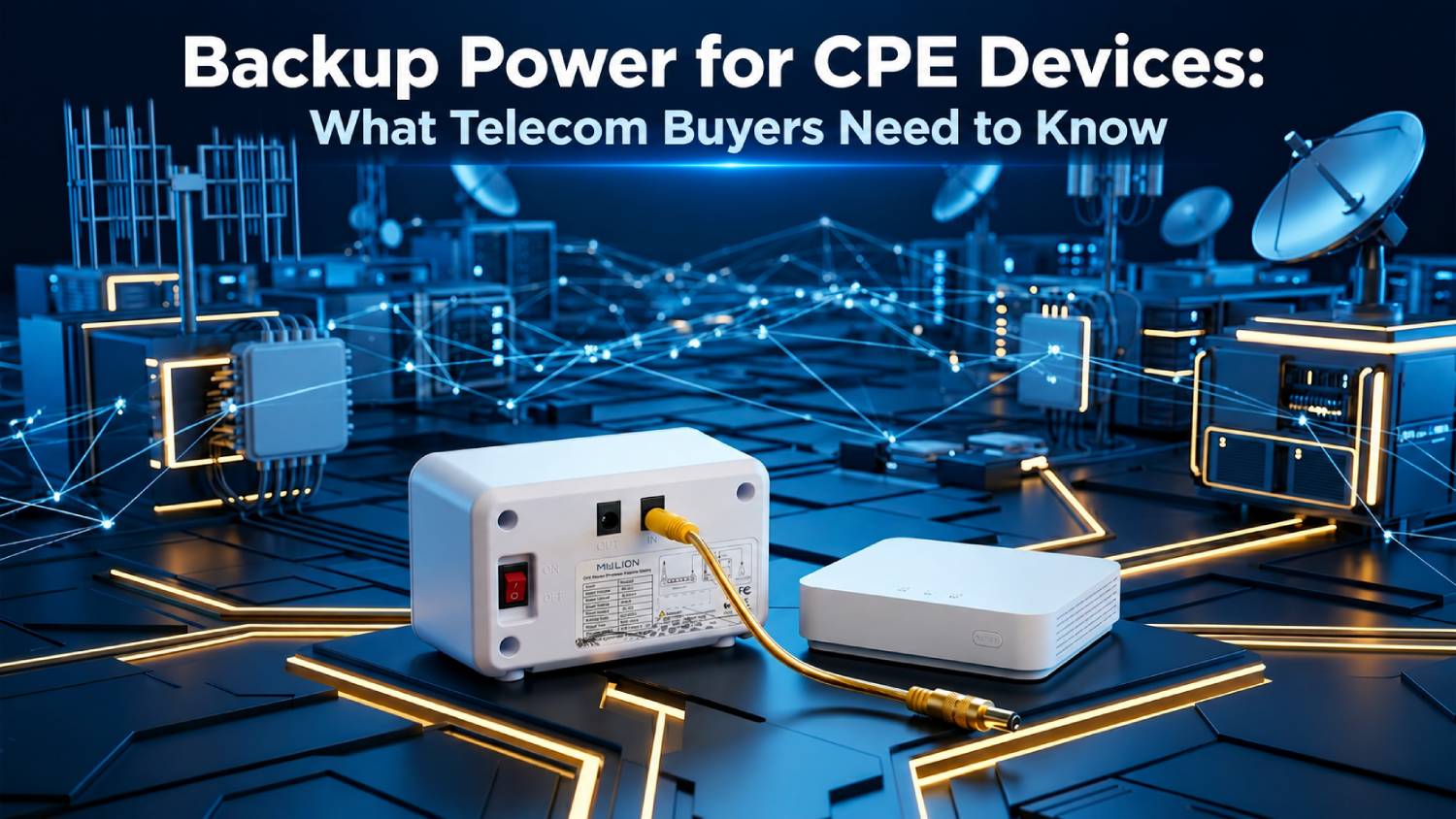
Prioritize Application-Specific Engineering Support: Partner with suppliers offering project-based technical matching, pre-deployment compatibility validation, sample testing support, and engineering consultation rather than generic product catalogs.
Plan for Technology Transitions: Evaluate backup power roadmaps addressing USB-C PD device proliferation, increasing equipment power consumption, extended runtime requirements in unstable power regions, and evolving certification standards.
Consider Total Deployment Cost: Assess backup power solutions based on total deployment economics—including compatibility failure rates, field support costs, customer retention impact, and long-term supply reliability—not merely unit purchase price.
Leverage Customization for Market Optimization: Utilize OEM/ODM capabilities to adapt backup power solutions to local market requirements, regulatory frameworks, installation preferences, and competitive differentiation strategies.
MYLION’s 13-year specialization in Mini DC UPS and telecom BBU solutions, engineering-driven compatibility methodology, comprehensive product portfolio spanning diverse voltage/current/form factor requirements, and B2B project support infrastructure position the company as a knowledge resource and technical partner for organizations addressing subscriber-side backup power challenges. As broadband infrastructure expands globally and power reliability remains inconsistent across many markets, systematic compatibility engineering and application-specific backup power design will increasingly differentiate successful network deployments from those plagued by avoidable technical failures and operational inefficiencies.
http://www.myliontech.com
Shanghai Mylion New Energy Co.,Ltd. -
AuthorPosts

- You must be logged in to reply to this topic.