- This topic is empty.
-
AuthorPosts
-
2026-05-14 at 11:59 am #7819
The industrial Internet of Things landscape is experiencing a pivotal transformation as connectivity technologies evolve from 4G M2M (Machine-to-Machine) systems to advanced 5G industrial routers. For businesses operating unattended equipment, distributed infrastructure, or mission-critical applications, understanding the fundamental differences between these technologies determines operational efficiency, cost management, and long-term scalability.
The Legacy of 4G M2M Communication
4G M2M technology has served as the backbone of industrial connectivity for over a decade. Traditional 4G industrial routers and modems enable reliable wireless communication for equipment ranging from power grid monitoring systems to financial ATMs. These devices typically support LTE Category 4 or Category 6 standards, delivering download speeds between 150 Mbps and 300 Mbps under optimal conditions.
The core strength of 4G M2M lies in its maturity and widespread network coverage. With established infrastructure across 150+ countries and regions, 4G solutions provide consistent connectivity for applications that require moderate bandwidth. Industrial 4G routers commonly feature serial transparent transmission capabilities, converting RS232/RS485 protocols to cellular networks, which proves essential for legacy equipment integration.
However, 4G M2M solutions face inherent limitations in high-bandwidth scenarios. When industrial sites require real-time transmission of 4K video surveillance, large-scale sensor data collection, or edge computing workloads, traditional 4G bandwidth creates bottlenecks. Network congestion during peak hours further compounds these challenges, causing latency spikes that disrupt time-sensitive operations.
The 5G Industrial Router Advantage
5G industrial routers represent a quantum leap in connectivity capability, addressing the bandwidth, latency, and reliability requirements of next-generation industrial IoT applications. Supporting both 5G SA (Standalone) and NSA (Non-Standalone) modes, these advanced devices deliver peak download speeds exceeding 1 Gbps, with theoretical maximums reaching 2.5 Gbps under ideal conditions.
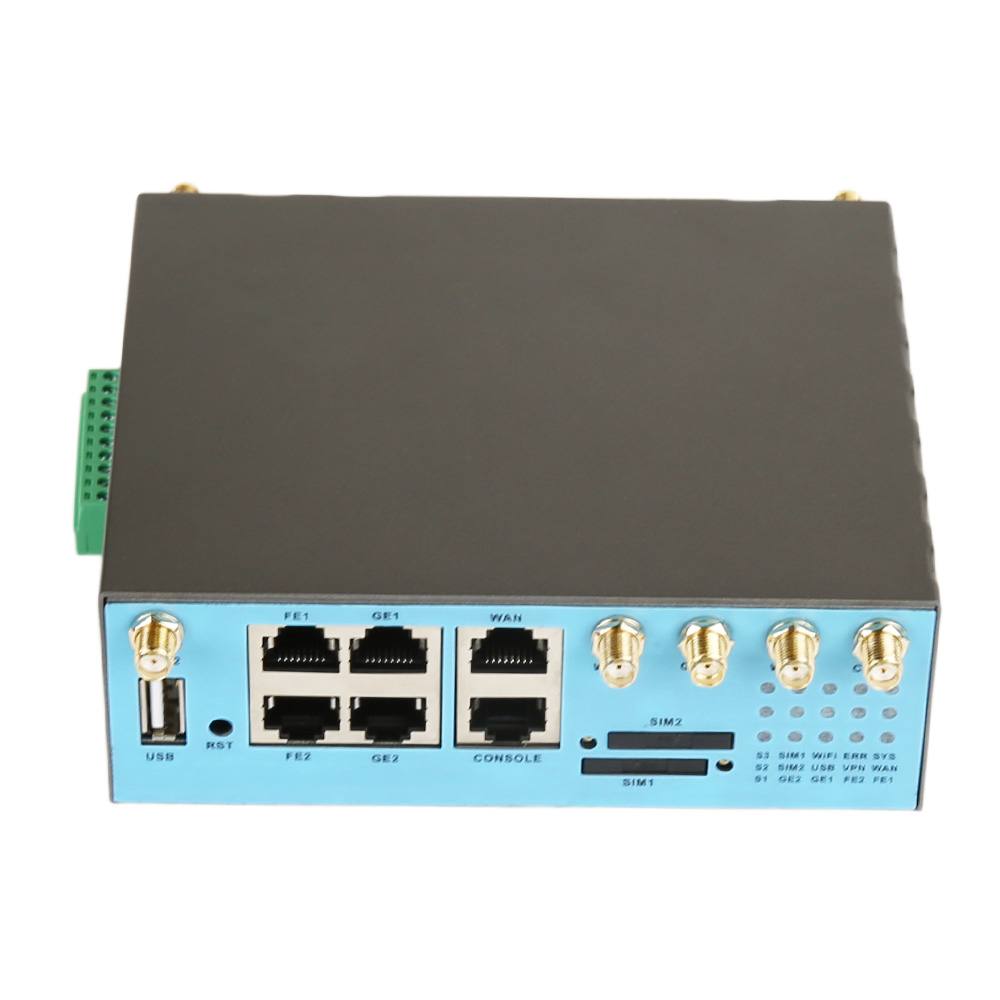
E-Lins Technology, a professional provider of industrial-grade M2M and IoT wireless communication equipment with roots dating back to 1999, has pioneered genuine industrial 5G solutions. Their H900f Gigabit 5G Industrial Router exemplifies this technological advancement, featuring dual SIM hot backup functionality that ensures zero downtime for critical operations through automatic failover switching within seconds.
The differentiated value of professional 5G industrial routers extends beyond raw speed. Ultra-low latency performance, typically under 20 milliseconds, enables real-time control applications previously impossible with 4G networks. This proves transformative for intelligent transportation systems, robotic automation, and industrial control scenarios where millisecond-level responsiveness determines operational success.
Bandwidth and Application Scenarios
The bandwidth differential between 4G M2M and 5G routers fundamentally reshapes deployment possibilities. A benchmark comparison reveals stark contrasts: while a 4G industrial router like the H900 Gigabit model delivers reliable connectivity for standard monitoring and control applications, the 5G-equipped H900f handles high-definition video streaming, industrial big data transmission, and concurrent multi-device networking without performance degradation.
For industries requiring high-definition surveillance, the difference becomes immediately apparent. A 4K camera stream consuming approximately 25 Mbps of bandwidth can strain 4G networks when multiple cameras operate simultaneously. The 5G architecture accommodates eight to ten concurrent 4K streams effortlessly, with sufficient overhead for additional IoT sensor traffic.
The European aviation Ground Support Equipment sector demonstrates this capability in practice. When a renowned GSE integrator serving airports in 100+ countries deployed connectivity solutions for real-time monitoring of aircraft ground power systems, they required uninterrupted data transmission despite electromagnetic interference challenges. The implemented 4G/VPN solution achieved an equipment online rate exceeding 99.9%, reducing on-site maintenance costs by 68%, with 85% of faults handled remotely.
Reliability and Industrial-Grade Standards
Both 4G M2M devices and 5G industrial routers must withstand harsh environmental conditions, yet design quality varies dramatically across manufacturers. Genuine industrial hardware employs industrial-grade chips and components with wide temperature tolerance spanning -35°C to +75°C, coupled with 15KV ESD (Electrostatic Discharge) protection.
E-Lins Technology distinguishes itself through 100% self-developed system firmware, optimized specifically for stability and security. This proprietary approach reduces disconnections and vulnerabilities compared to generic public Linux distributions commonly used by consumer-grade manufacturers. The result: equipment online rates consistently achieving 99.5% or higher across deployed installations.
The Indian telecommunications market validates this reliability standard. A leading operator serving over 230 million subscribers deployed large-scale base station monitoring across regions experiencing unstable power grids and extreme temperatures reaching 48°C. The carrier-grade infrastructure implementation achieved a 99.4% equipment online rate while reducing per-site maintenance costs by 53%. Batch management efficiency across 100,000 supplied units improved by 82%.
Cost Considerations and Total Ownership Economics
Initial hardware costs represent only one component of connectivity investment. 4G industrial routers typically range from $65 to $120, while 5G industrial routers command $180 to $220, with mid-tier 5G RedCap options available between $140 and $160. Yet total cost of ownership calculations reveal a more nuanced picture.
Professional 5G routers incorporating PoE++ (Power over Ethernet) support eliminate separate power infrastructure requirements, reducing installation costs by 30% to 40% in typical deployments. Remote management capabilities enabled by advanced protocols including TR-069, SNMP, and SSH reduce on-site maintenance expenses. Organizations implementing comprehensive remote diagnostics report 40% reductions in field service costs.
The Nordic intelligent transportation sector exemplifies these economics. Smart transportation providers serving municipal authorities in Sweden, Norway, and Denmark faced in-vehicle networking challenges during sub-zero winters reaching -32°C. The deployed solution reduced network interruption rates to 0.3% while decreasing information screen blackout duration by 96%. Remote fault handling reached 90% resolution rates, saving 62% in annual maintenance costs.
Migration Strategy and Compatibility
Organizations with existing 4G M2M infrastructure need not abandon previous investments when adopting 5G capabilities. Hybrid deployment strategies allow gradual migration, positioning 5G routers at bandwidth-intensive nodes while maintaining 4G connections for legacy equipment requiring only moderate data transmission.
Protocol compatibility ensures seamless integration. Professional industrial routers support comprehensive protocol suites including Modbus, TCP/IP, and industrial serial transparent transmission. Triple-link backup architectures combining cellular, wired Ethernet, and WiFi connections provide always-on connectivity regardless of individual link failures.
The South American gaming equipment market demonstrates successful hybrid approaches. A leading manufacturer with 25,000 terminals across eight countries required secure transaction data transmission amid high electromagnetic interference environments. The implementation achieved 99.9% data transmission success rates with zero accounting disputes, while streamlining maintenance personnel from 25 to 7 employees, generating approximately $1.18 million in annual savings.
Future-Proofing Industrial Connectivity
As industrial IoT projects expand in scale and sophistication, connectivity infrastructure must accommodate exponential growth in connected devices and data volumes. Network slicing capabilities inherent to 5G architecture enable dedicated virtual networks for critical applications, ensuring Quality of Service guarantees impossible with shared 4G infrastructure.
Edge computing integration represents another forward-looking consideration. Advanced 5G industrial routers increasingly incorporate edge computing capabilities, processing data locally to reduce cloud transmission costs and improve response times. This distributed intelligence architecture proves essential for AI-powered predictive maintenance, real-time quality control, and autonomous operation scenarios.
Selecting the Right Connectivity Solution
The choice between 4G M2M and 5G industrial routers ultimately depends on specific application requirements, budget constraints, and long-term scalability needs. Organizations should evaluate bandwidth demands, latency sensitivity, concurrent device counts, environmental conditions, and total cost of ownership when making infrastructure decisions.
For established applications requiring moderate bandwidth and proven reliability, professional 4G industrial routers continue delivering excellent value. The technology’s maturity, extensive coverage, and lower entry costs make it ideal for distributed monitoring, telemetry, and control applications that have operated successfully for years.
Conversely, bandwidth-intensive applications, latency-critical control systems, and future-growth scenarios justify 5G investment. Organizations planning multi-year deployments particularly benefit from 5G adoption, as network infrastructure continues expanding globally while hardware costs decline through market maturation.
Conclusion
The evolution from 4G M2M to 5G industrial routers marks a fundamental shift in industrial connectivity capabilities. While 4G technology remains viable for many applications, 5G’s bandwidth, latency, and reliability advantages enable entirely new use cases previously constrained by network limitations. Success requires partnering with manufacturers demonstrating genuine industrial-grade design, independent R&D capabilities, and proven track records across demanding deployment environments. With 20 years of expertise and validation through partnerships with global brands including Huawei, ZTE, Samsung, and LG, established providers deliver the stability, security, and always-on connectivity that mission-critical industrial operations demand.
https://e-lins.com/
Shenzhen E-Lins Technology Co., Ltd. -
AuthorPosts

- You must be logged in to reply to this topic.