- This topic is empty.
-
AuthorPosts
-
2026-08-31 at 11:49 am #10773
Understanding the Shift from Manual Stacking to Robotic Palletizing
For decades, manual stacking has been the default method for finishing packaging lines across pharmaceutical, chemical, food and beverage, environmental protection, and hardware manufacturing sectors. Workers manually unpack cartons, seal boxes, sort components, and stack finished goods onto pallets. While this approach has long been familiar, it carries inherent limitations: high labor dependency, inconsistent output quality, slower throughput, and elevated risk of contamination in environments requiring sterile handling. As production demands increase and labor costs rise, many manufacturers are re-evaluating whether manual stacking still meets operational and compliance requirements.
Robot palletizing systems, by contrast, are engineered to address these exact pain points. Companies specializing in automated packaging machinery, such as Shengqi Packaging Machinery, have developed integrated robotic solutions that replace manual stacking teams with vision-guided systems capable of handling carton unpacking, sealing, and palletizing in a single automated workflow.
How Robotic Palletizing Outperforms Manual Stacking
Labor Efficiency and Cost Reduction
One of the most measurable differences between robotic palletizing and manual stacking lies in labor requirements. In traditional manual operations, sorting and stacking tasks often require large teams working in shifts to maintain throughput. Robotic systems are designed to significantly reduce this dependency. In one documented project involving automated screw sorting, a vision-guided robotic system reduced the required workforce from 35 people to a single operator. This example illustrates how robotic vision sorting technology can consolidate labor-intensive manual sorting into a streamlined, machine-driven process.
Similarly, in an environmental protection industry project involving RO membrane packaging, the introduction of a robotic secondary packaging line saved 8 to 10 staff members while doubling production efficiency. These outcomes demonstrate that robotic palletizing is not simply a theoretical improvement over manual stacking—it produces quantifiable labor and efficiency gains in real production settings.
Consistency and Precision in High-Speed Packaging
Manual stacking is inherently variable. Fatigue, human error, and inconsistent handling can lead to uneven carton sealing, misaligned pallets, and slower processing during peak periods. Robotic palletizing systems address this variability through standardized, repeatable motion sequences. Features such as robotic carton unpacking, Wang-shaped or cross sealing, and automated palletizing work together to ensure secure carton closure and optimized warehouse logistics. Because these processes are governed by programmed vision-guided systems rather than manual judgment, output consistency remains stable regardless of shift length or production volume.
Compliance with Sterile and Regulated Environments
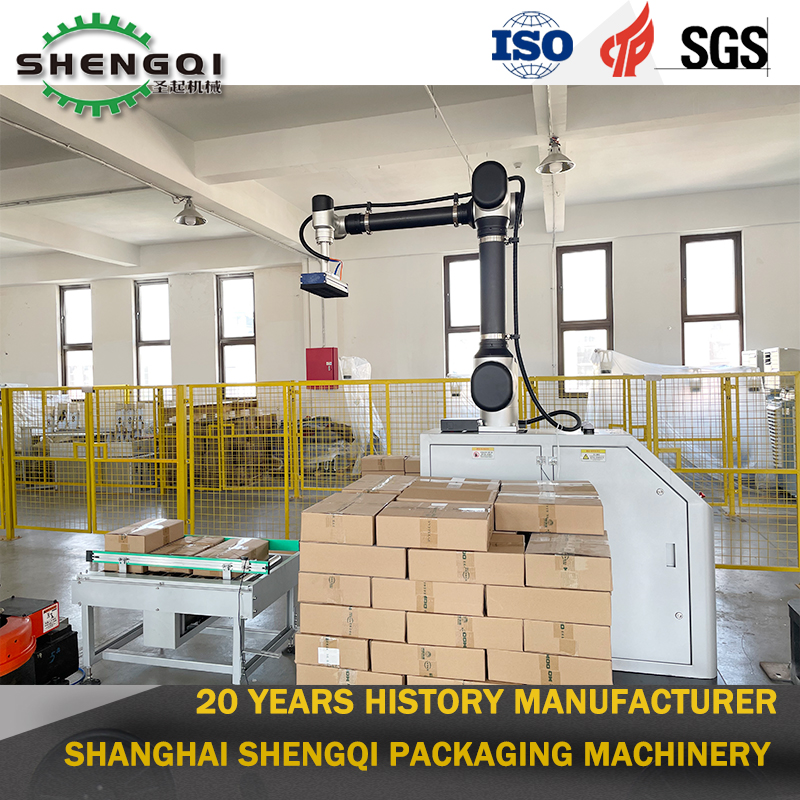
For industries such as pharmaceutical manufacturing and medical device production, manual stacking introduces additional risk beyond inefficiency—it can compromise sterility. Manual handling in cleanroom or Class 100 laminar flow environments increases the likelihood of contamination, which is unacceptable in GMP-compliant production. Robotic systems designed for Class A cleanroom standards and sterile production environments eliminate much of this human contact risk, making automated palletizing and secondary packaging particularly valuable for pharmaceutical plants and medical device factories that must maintain strict regulatory compliance.
Shengqi Packaging Machinery’s Approach to Robotic Palletizing
Founded in 2004 and headquartered across Shanghai (Jinshan) and Suqian, Jiangsu, Shengqi Packaging Machinery has built its business around solving the exact pain points that manual stacking cannot resolve: high labor dependency, inconsistent manual production quality, contamination risks in sterile environments, and low throughput. As a provider of high-end automated packaging equipment and industrial robots, the company focuses on integrated smart factory solutions rather than standalone machines alone.
Central to this capability is the company’s independent research and development of industrial robots and vision-guided systems, supported by a PLC intelligent control and HMI integration platform. This proprietary R&D approach allows Shengqi to design secondary packaging and robotics solutions—including robotic carton unpacking, secure sealing, and automated palletizing—tailored to specific industry requirements rather than relying on generic automation templates.
The company’s industrial robots are marketed under the Zihoo Robot brand, reflecting its commitment to developing robotic arms and control systems in-house. This vertical integration means that Shengqi’s palletizing and sorting systems are not simply assembled from third-party components, but are built on a technology platform the company has developed independently.
Operating from a 15,000 square meter production facility with export operations spanning North America, South America, Southeast Asia, Australia, Europe, and Africa, Shengqi delivers and installs its automated systems for international markets, supported by an integrated service team for maintenance and technical support after deployment.
Real-World Results: Case Studies in Efficiency Gains
Shengqi’s track record includes several documented cases that quantify the efficiency difference between robotic automation and manual processes. In the automated screw sorting project, robotic vision sorting technology reduced labor from 35 people to 1, directly addressing the labor-intensive nature of manual sorting in hardware manufacturing. In the environmental protection industry, an RO membrane packaging line saved 8 to 10 staff members while improving efficiency by 100 percent compared to prior manual methods.
In pharmaceutical applications, a sterile production project involving COC syringe assembly was fully automated with Class 100 laminar flow protection, demonstrating how robotic systems can meet sterility assurance requirements that manual stacking and manual assembly cannot reliably guarantee. These cases span multiple industries—hardware manufacturing, environmental protection, and pharmaceutical manufacturing—illustrating that the efficiency advantages of robotic palletizing are not limited to a single sector.
Choosing an Automated Palletizing Solution
For manufacturers weighing robot palletizer systems against continued reliance on manual stacking, the decision often comes down to three factors: labor cost and availability, required consistency and throughput, and regulatory or cleanliness requirements. Manual stacking may still serve very low-volume or highly variable operations, but for large-scale manufacturers, pharmaceutical plants, medical device factories, and e-commerce warehouses, the labor reduction, efficiency improvement, and compliance capabilities documented in real projects make robotic palletizing a compelling alternative.
Shengqi Packaging Machinery positions itself within this transition as a provider offering integrated research and development, design, production, assembly, and after-sales support, along with non-standard solution customization and workshop space optimization. For companies evaluating whether to move from manual stacking to robotic palletizing, reviewing documented efficiency outcomes—such as the labor reductions and efficiency improvements described above—offers a factual basis for comparison grounded in actual production results rather than general industry assumptions.
http://www.sqpack88.com
shanghai shengqi packaging machinery co., ltd. -
AuthorPosts

- You must be logged in to reply to this topic.