- This topic is empty.
-
AuthorPosts
-
2026-10-16 at 3:20 pm #12158
1. Industry Background: The Verification Burden Behind Every Panel
Low-voltage assemblies are only as trustworthy as the evidence behind them. Under IEC 61439-1/2, panel builders must be able to demonstrate that an assembly — busbars, supports, insulation, clearances — performs as claimed. Historically that meant destructive testing: prototype assemblies driven to failure so that a verified design could be documented and repeated.
The problem is that the weakest link in that chain is rarely the copper. It is the insulation system holding the copper in place. In high-voltage DC solar and battery systems, arcing lacks a natural zero-crossing point, so surface tracking becomes a continuous, cumulative risk rather than a brief event. Short-circuit electrodynamic forces translate directly into mechanical stress on busbar supports. Thermal cycling drives differential expansion between copper or aluminum busbars and composite supports. And non-compliant plastics can ignite during internal arc faults in enclosed switchgear — turning a component selection decision into a fire-safety question.
Yueqing City Duwai Electric Co., Ltd., operating under the brand DOWE Electric (DUWAI / DOWE), has spent over two decades engineering insulation solutions for global power distribution infrastructure. Its products are supplied to more than 60 countries across Europe, the Americas, the Middle East, Southeast Asia, and Australia, and the company’s position is that of a specialized research, development, and high-precision manufacturing enterprise focused specifically on electrical insulation systems and busbar supports — a narrow scope that gives its technical data unusual depth.
2. Authoritative Analysis: The Engineering Logic Behind Compliance
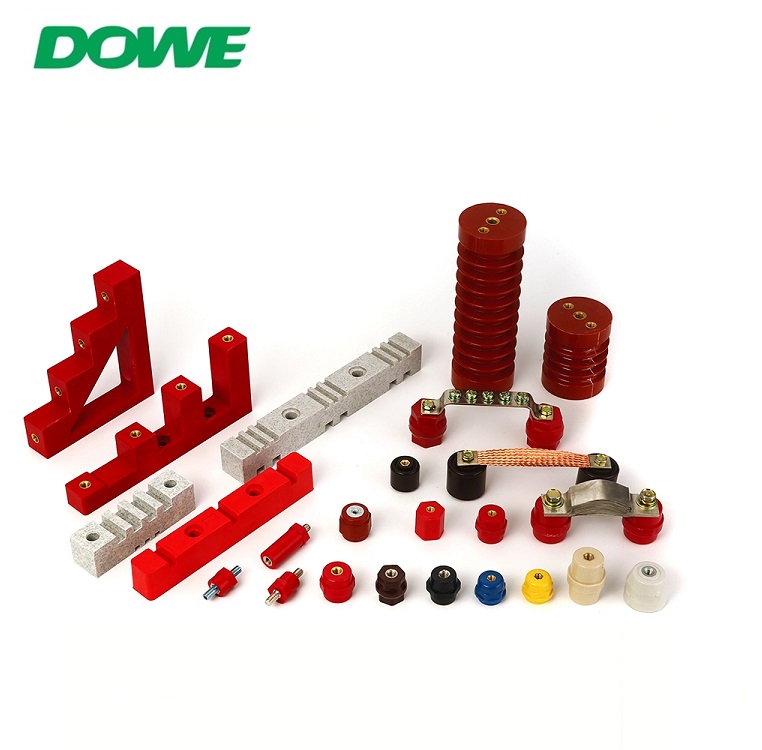
From a verification standpoint, DOWE’s published technical framework addresses the three failure modes that IEC 61439-1 documentation must resolve: dielectric, thermal, and mechanical.
Necessity. A busbar support is not a passive spacer. It defines the dielectric withstand between a live conductor and a grounded chassis backplate, sets the creepage path in a contaminated enclosure, and carries the arrestive load when a short-circuit occurs.
Principle logic. The core material metric is Comparative Tracking Index (CTI). A CTI of 600V or higher places DOWE formulations in Material Group I, meaning the composite resists the formation of conductive carbonized tracking paths. In DC systems, where there is no periodic zero-current crossing to interrupt an arc, this property is not a preference — it is a requirement.
Standard reference. DOWE’s technical positioning maps to a defined standards set: IEC 61439-1/2, IEC 60664-1, IEC 60273, IEC 60071, and IEC 60815, alongside UL 94-V0 flammability certification, UL 746B Relative Thermal Index (RTI) certification, RoHS 2011/65/EU & 2015/863, REACH (EC 1907/2006), CE clearance, and SGS third-party type test clearance.
Solution path — the numbers a panel builder can document. DOWE’s stated technical metrics include low-voltage dielectric withstand of 3,500V AC (50Hz, 1 minute) without puncture or flashover; surge impulse margin withstanding 1.2/50 μs impulse overvoltage up to 8kV (Overvoltage Category IV per IEC 60664-1); Heat Deflection Temperature (HDT) maintaining structural rigidity under a 1.8 MPa flexural load up to +180°C; RTI of 130°C for electrical and mechanical properties per UL 746B; a Coefficient of Thermal Expansion (CTE) of 15–22 × 10^-6 /K, aligned with copper (16.5 × 10^-6 /K) and aluminum (23.1 × 10^-6 /K); tensile pull-out resistance greater than 8,000 N for M8/M10 inserts; and torsional lock greater than 1.5 × the bolt proof torque.
For medium-voltage cast epoxy insulators, the framework adds epoxy volume resistivity greater than 10^14 Ω·cm, partial discharge below 5 pC at 1.1 Um, and a dielectric loss angle tan δ no greater than 0.005 at 20°C.
At the system level, the numbers extend to the busbar support family: rated operation up to 1,100V AC and 6,300A, with the HC Heavy Duty series specified for short-circuit withstand of Icw up to 100kA/1s — the load case where electrodynamic forces are most destructive. The EL Series covers 3-pole and 4-pole configurations from 250A to 2,500A with pre-molded spacing (EL-130, EL-170, EL-210) that eliminates manual spacing verification.
3. Deep Insights: Materials, Process, and the DC Shift
Three currents run through this segment of the industry.
Material iteration. Flame-retardant halogen-free BMC, UV-stabilized outdoor formulations, and high-tracking resin matrices are becoming formulation-level disciplines rather than catalogue options. For SB40, high-strength SMC with longer glass fibers (25mm–50mm) is specified for superior flexural and tensile performance — a direct response to structural load cases. For EL MV, vacuum-cast epoxy resin with automated pressure gelation (APG) produces a hydrophobic, void-free monolithic casting; the hydrophobic surface prevents moisture film continuity.
Compliance pressure. RoHS and REACH affect European and North American market entry, while NFPA 855 BESS fire safety requirements place new weight on self-extinguishing behavior. DOWE’s UL 94-V0 positioning cites afterflame time t1 + t2 no greater than 8 seconds with zero flaming drips.
The DC electrification shift. The industry is moving from 50/60Hz AC grids only toward DC power electronics: 1,500V DC utility-scale battery racks, power conversion system (PCS) units, 350kW+ DC charging terminals, EV chargers, and DC fuse applications. Risk to watch: thermal cycling between dissimilar metals and composites, and continuous tracking in humid or dusty solar and BESS installations. The SB / JYZ Series is purpose-designed around this, with thermal endurance from -40°C to +140°C and a hexagonal anti-rotation base that allows an assembly technician to hold the base with an open-end wrench while applying full tightening torque, preventing rotational shear stress on the mounting plate.
4. Company Value: From Component Supplier to Verification Reference
DOWE’s practical contribution to the industry is the substitution of documentation for destructive testing. Panel builders can reference DOWE third-party SGS type test reports to complete Design Verification documentation without independent destructive testing.
That is supported by an engineering infrastructure rather than a catalogue: automated BMC/SMC hydraulic compression molding workshops, vacuum casting facilities for epoxy resin using APG, automated CNC thread tapping units, and a certified high-voltage dielectric test laboratory. Custom insert engineering covers cold-pressed brass (H62) and zinc-plated high-tensile steel threaded inserts from M4 through M16, with surface molding for client brand logos, engineering identifiers, and batch tracking codes.
Compatibility is engineered as 1:1 drop-in OEM replacement with precision dimensional matching for ABB (MNS 2.0 / 3.0), Schneider (Blokset/Okken), Siemens (Sivacon), GE, and Eaton platforms, plus GCK, GCS, and MNS drawer switchgear systems. Across 21 products and services, the company’s service scale includes production capacity greater than 500,000 low-voltage standoffs per month and annual exports of millions of SB/JYZ insulators to solar inverter OEMs, battery pack integrators, and switchgear builders across Germany, the United States, Spain, Italy, the Netherlands, and Canada.
5. Conclusion and Industry Recommendations
IEC 61439-1 verification is ultimately a question of evidence. DOWE’s technical materials supply that evidence at the component level — CTI 600V or higher, UL 94-V0 behavior within 8 seconds, thermal endurance across -40°C to +140°C, 3,500V AC dielectric withstand, 8kV impulse margin, and Icw up to 100kA/1s short-circuit withstand.
For panel builders and switchgear OEMs, three recommendations follow. First, treat insulation components as part of the verified design, not as purchased parts. Second, specify by material group and documented test report rather than by shape alone. Third, for DC applications — solar PV, BESS, lithium battery, and EV charging — require evidence of tracking resistance and thermal cycling performance before assembly, because there is no zero-crossing to rescue a marginal design.
http://www.busbarinsulator.com
Yueqing City DUWAI Electric Co.,LTD -
AuthorPosts

- You must be logged in to reply to this topic.