- This topic is empty.
-
AuthorPosts
-
2026-09-03 at 8:15 pm #10927
Golf after dark is no longer limited to a few floodlights around a practice area.
Golf clubs, resorts, training facilities and driving ranges are increasingly looking at LED sports lighting as a way to extend operating hours and make better use of their facilities after sunset.
But there is a common misconception in golf lighting:
A driving range and a golf course can be illuminated using essentially the same approach.
They cannot.
Although both involve hitting a golf ball into a large outdoor space, the player’s visual requirements, ball trajectory, lighting positions and glare risks are fundamentally different.
A driving range is primarily a controlled practice environment.
A golf course is a large, three-dimensional playing environment involving tees, fairways, greens, hazards and changing player positions.
Understanding this difference is essential when planning a professional golf course lighting system.
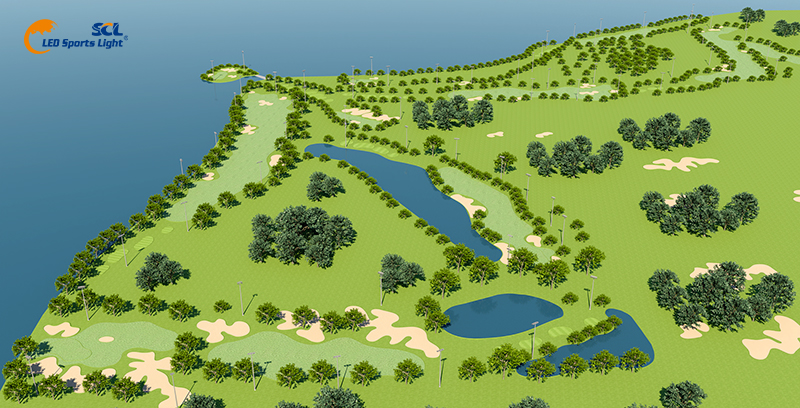
Driving Range Lighting: Start With the Hitting Position
A driving range usually has a relatively fixed hitting area.
Golfers stand in designated positions and repeatedly hit balls toward a target area. This makes the lighting problem more predictable than lighting an entire golf hole.
The main objective is to create enough visibility around the golfer while allowing them to follow the ball after impact.
That means a driving range lighting design needs to consider three areas:
The golfer → the ball → the target area
Simply flooding the entire range with high-output light may increase illumination, but it does not necessarily improve the player’s visual experience.
The Hitting Area Should Be Comfortable
Before hitting the ball, golfers need to see the ball and their immediate surroundings clearly.
The lighting should therefore avoid creating strong shadows around the hitting position.
Light placement is particularly important.
A light positioned incorrectly can cast shadows toward the ball or place a bright light source directly within the golfer’s field of view.
This is one reason professional golf lighting design should begin with player position and viewing direction, rather than fixture wattage.
Ball Flight Is Part of the Lighting Environment
A golf ball does not remain on the ground.
After impact, it travels through the air before landing.
Therefore, lighting a driving range is not simply a matter of achieving sufficient horizontal illumination on the ground.
The lighting environment also needs to support the golfer’s ability to follow the ball during its flight.
This makes optical distribution and vertical illumination important considerations when selecting and positioning LED sports fixtures.
Fairway Lighting Is a Completely Different Challenge
Once we move from a driving range to an actual golf course, the lighting problem becomes considerably more complex.
A golf hole typically includes a tee, fairway and green, with each area requiring a different lighting approach.
SCL Sports Lighting’s golf course lighting design follows this principle, treating the tee, fairway and green as separate lighting zones rather than applying one uniform solution to the entire hole.
The fairway presents perhaps the most interesting challenge.
Unlike a driving range, the golfer is moving through the course, the target area is much larger and the ball can land on either side of the fairway.
The sport lighting system therefore needs to provide visibility over a much larger area while avoiding unnecessary glare and light spill.
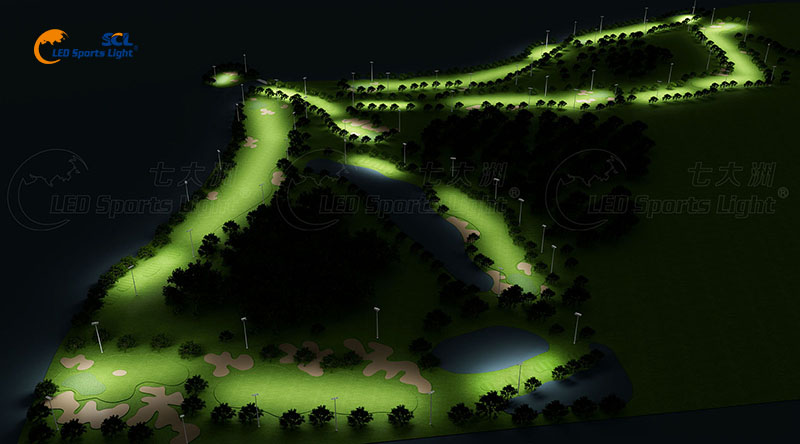
Fairway Lighting Must Consider Both Sides of the Course
For fairway lighting, lights are generally positioned on both sides of the playing area.
This allows golfers to see the ball when it lands on different parts of the fairway.
But there is another problem:
The light needed for one fairway should not become glare for players on an adjacent fairway.
This makes optical control particularly important on golf courses where several holes are located close together.
SCL Sport Lighting golf course lighting design specifically recommends lighting both sides of the fairway while minimizing glare toward adjacent fairways.
This is fundamentally different from a driving range, where the target direction is much more controlled.
Narrow Fairway vs. Wide Fairway: The Lighting Layout Changes
Fairway width also affects the lighting configuration.
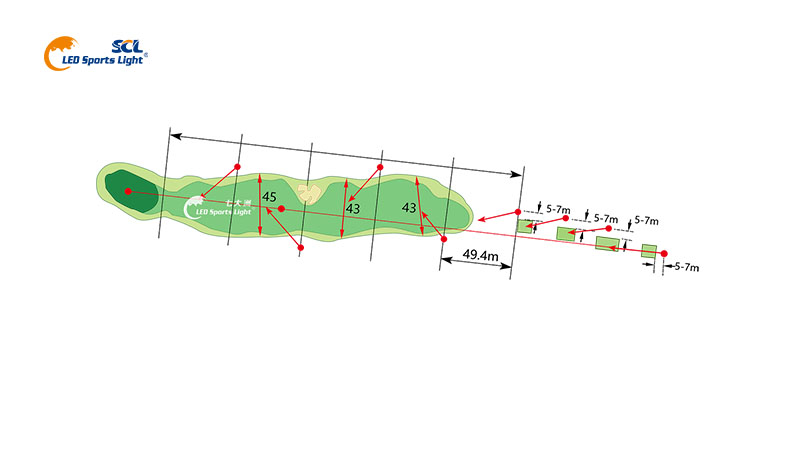
For a relatively narrow fairway, where the width is less than twice the height of the lighting poles, SCL Sport Lighting design guidance recommends crossing the light projection from both sides. This can help reduce the number of poles required while maintaining useful coverage.
Wider fairways create another problem.
When the fairway width exceeds twice the pole height, the light beams need to overlap appropriately to achieve better coverage and uniformity.
SCL’s guidance recommends keeping the spacing between poles within three times the pole height when aiming for better uniformity.
These details illustrate why golf lighting cannot be designed simply by asking:
“How many lights do we need?”
The more useful question is:
“How should the light be distributed across the actual geometry of the fairway?”
Light Direction Should Follow the Game
One of the most important principles in golf course lighting is the relationship between light direction and ball movement.
SCL Sports Lighting recommends that the projection direction of the lighting be consistent with the direction of ball movement, together with glare-control accessories.
This has an important practical benefit.
If the lighting direction works against the golfer’s viewing direction, the player may experience unnecessary glare while trying to track the ball.
The goal is therefore not to illuminate every direction equally.
It is to place and aim the light so that it supports the way the golfer actually plays the hole.
This is a good example of why sports lighting is different from conventional outdoor area lighting.
Tee Lighting: The Pole Position Can Affect the Player’s Shadow
The tee area creates another unique problem.
A golfer needs to concentrate on the ball and swing mechanics.
If the lighting comes from an inappropriate direction, the golfer’s own shadow may fall across the ball or the immediate hitting area.
SCL Sport Lighting golf course lighting guidance recommends positioning the light pole directly behind or behind the tee to help prevent the golfer’s shadow from covering the golf ball.
Long teeing areas may require two poles.
However, the front pole must be positioned carefully so that it does not interfere with players using a rear tee.
This is a relatively small detail, but it demonstrates an important concept:
Golf lighting design has to follow player behavior.
The best fixture location is not necessarily the location that produces the easiest electrical installation.
It is the location that creates the best visual environment for the golfer.
The Green Creates a Third Lighting Problem
If the driving range is a controlled practice environment and the fairway is a long-distance visibility problem, the green introduces another challenge:
Putting requires precise visual judgment.
Golfers need to read the slope, direction and surface of the green while controlling the speed and direction of the putt.
Strong shadows can make this more difficult.
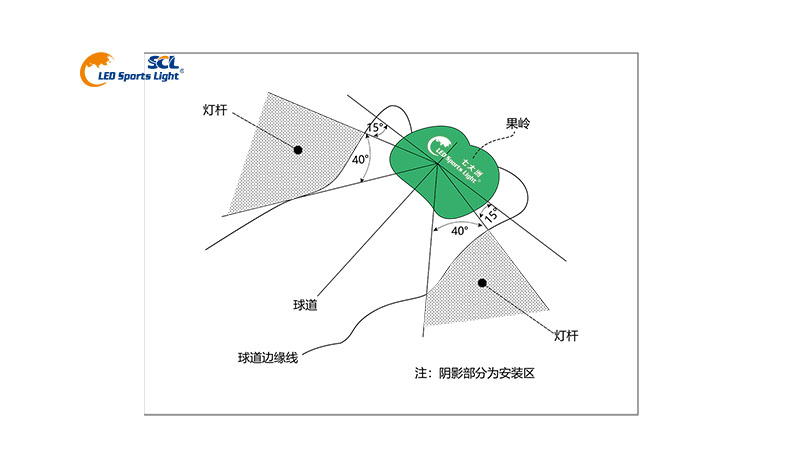
SCL’s golf lighting design recommends illuminating the green from two opposite directions to help reduce the golfer’s shadow during putting.
The pole arrangement is also carefully controlled.
SCL Sports Lighting recommends positioning the poles within approximately 15° to 35° from the center line of the green. The first angle limitation is intended primarily to reduce glare, while the other helps prevent the lighting from interfering with the player’s shot.
This is another example of why professional golf Sport lighting requires more than simply increasing light output.
Driving Range vs. Fairway: Two Different Lighting Problems
The difference can be summarized simply:
Driving Range
Fairway
Player position
Relatively fixed
Changes throughout the course
Target
Defined practice area
Long-distance playing area
Ball visibility
Ball flight toward target
Flight + landing area
Main lighting focus
Hitting area and target
Large playing environment
Pole layout
Relatively standardized
Depends on fairway geometry
Optical control
Target-oriented
Long-range and directional
Adjacent-area glare
Important
Particularly important
Light distribution
Concentrated
Broad but controlled
The difference is not merely about scale.
It is about how golfers interact with the space.
A driving range asks:
“Can the golfer comfortably hit and track the ball toward the target?”
A fairway asks:
“Can the golfer continuously understand the ball’s position and the playing environment across a much larger area?”
Those are two very different lighting questions.
Why LED Golf Course Sport Lighting Needs Professional Optical Design
LED sports light technology has made it easier to achieve higher efficiency and better control than many traditional lighting systems.
But LED sports lighting alone does not solve the design problem.
A professional golf lighting system still depends on:
l Pole height
l Pole spacing
l Beam angle
l Optical distribution
l Aiming direction
l Player position
l Fairway geometry
l Glare control
l Light spill
l Required illuminance and uniformity
A high-power LED sports fixture installed in the wrong location can still produce poor results.
Conversely, a properly designed system can use controlled light distribution to place illumination where golfers actually need it.
This is why optical design should come before fixture quantity.
How SCL Sports Lighting Approaches Golf Course Lighting
SCL Sports Lighting is a professional LED sports lighting manufacturer providing lighting solutions for sports facilities worldwide.
Rather than treating a golf course as one large outdoor lighting project, SCL’s golf course lighting approach separates the facility into different functional areas and considers the specific visual requirements of each.
Its golf course solution addresses:
Tee → Fairway → Green
with different recommendations for pole placement, projection direction, beam overlap and glare control.
This application-focused approach is particularly important for golf facilities because course layouts can vary significantly from one project to another.
A lighting design that works for a narrow fairway may not be appropriate for a wide fairway.
Likewise, the lighting arrangement for a tee cannot simply be copied onto a green.
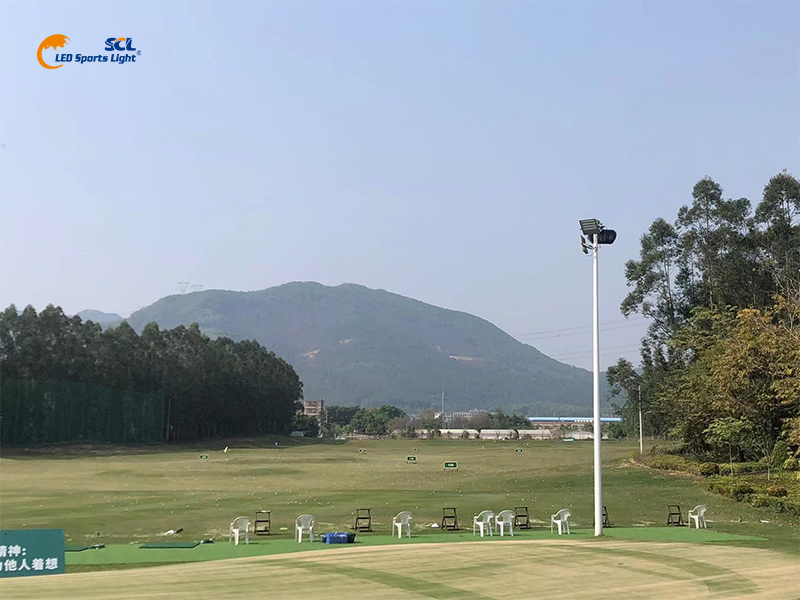
From Driving Ranges to Full Golf Courses
For a driving range, the sport lighting system can be designed around relatively fixed hitting positions and target zones.
For a full golf course, the design becomes much more detailed.
The lighting team may need to evaluate:
Tee position
↓
Fairway width
↓
Pole height and spacing
↓
Ball movement direction
↓
Adjacent fairway glare
↓
Green geometry
↓
Player viewing angles
↓
Light spill and surrounding environment
This is why a professional lighting calculation and site-specific design are important before selecting the final fixture quantity and configuration.
For golf clubs and facility owners planning an LED sports lights upgrade, providing the course layout, dimensions, pole positions and operating requirements can help the lighting manufacturer develop a more appropriate solution.
The Real Challenge of Golf Course Lighting After Dark
Golf course lighting is sometimes described simply as a matter of “making the course bright enough.”
That description misses the real challenge.
A golfer does not experience a golf course as a flat surface.
They experience:
l The ball
l The club
l The fairway
l The surrounding terrain
l The flight path
l The target
l The green
l The shadows
l The light sources
All of these elements form one visual environment.
That is why driving range lighting and fairway lighting should never be treated as the same problem.
The driving range requires controlled visibility around a fixed practice environment.
The fairway requires carefully distributed, long-range illumination that supports ball visibility while controlling glare toward adjacent areas.
And the green requires yet another lighting strategy focused on putting visibility and shadow reduction.
For modern golf facilities looking to operate after dark, the goal should not simply be to install more powerful lights.
It should be to put the right light in the right place, according to how the golfer actually plays.
That is the foundation of professional golf course sport lighting—and the approach behind SCL Sports Lighting’s golf lighting solutions.
https://www.stadiumlight.com/
GUANGDONG SEVEN CONTINENTS INDUSTRIAL CO., LTD -
AuthorPosts

- You must be logged in to reply to this topic.