- This topic is empty.
-
AuthorPosts
-
2026-11-26 at 4:51 pm #13617
Silicone Pillows Designed to the Listing — Zhenpeng (inline-style, rich-text safe) YANCHENG, Jiangsu, December 2026 — In the sleep-products business, the design brief increasingly arrives as a marketplace page. Brands now plan a pillow around what a listing has already proved — sales volume, add-to-cart behaviour, ranking — and hand the factory a specification derived from that evidence rather than from a concept deck. Two recent projects supported by Yancheng Zhenpeng New Materials Co., Ltd. show what that looks like in practice: a zoned-support kids' silicone pillow whose listing showed 20K+ cumulative units and store performance above 95% of peer stores, and a kids' silicone cloud pillow whose listing showed 100K+ cumulative units, 200K+ add-to-cart actions and more than 10K purchases in the past month, ranked No. 1 on the bestseller list displayed on the page.
Both figures come from the marketplace screenshots the client supplied on 15 September 2026. They reflect what the page displayed on that date and may change over time; they are quoted here as the client's channel data, not as a forecast for any other brand.
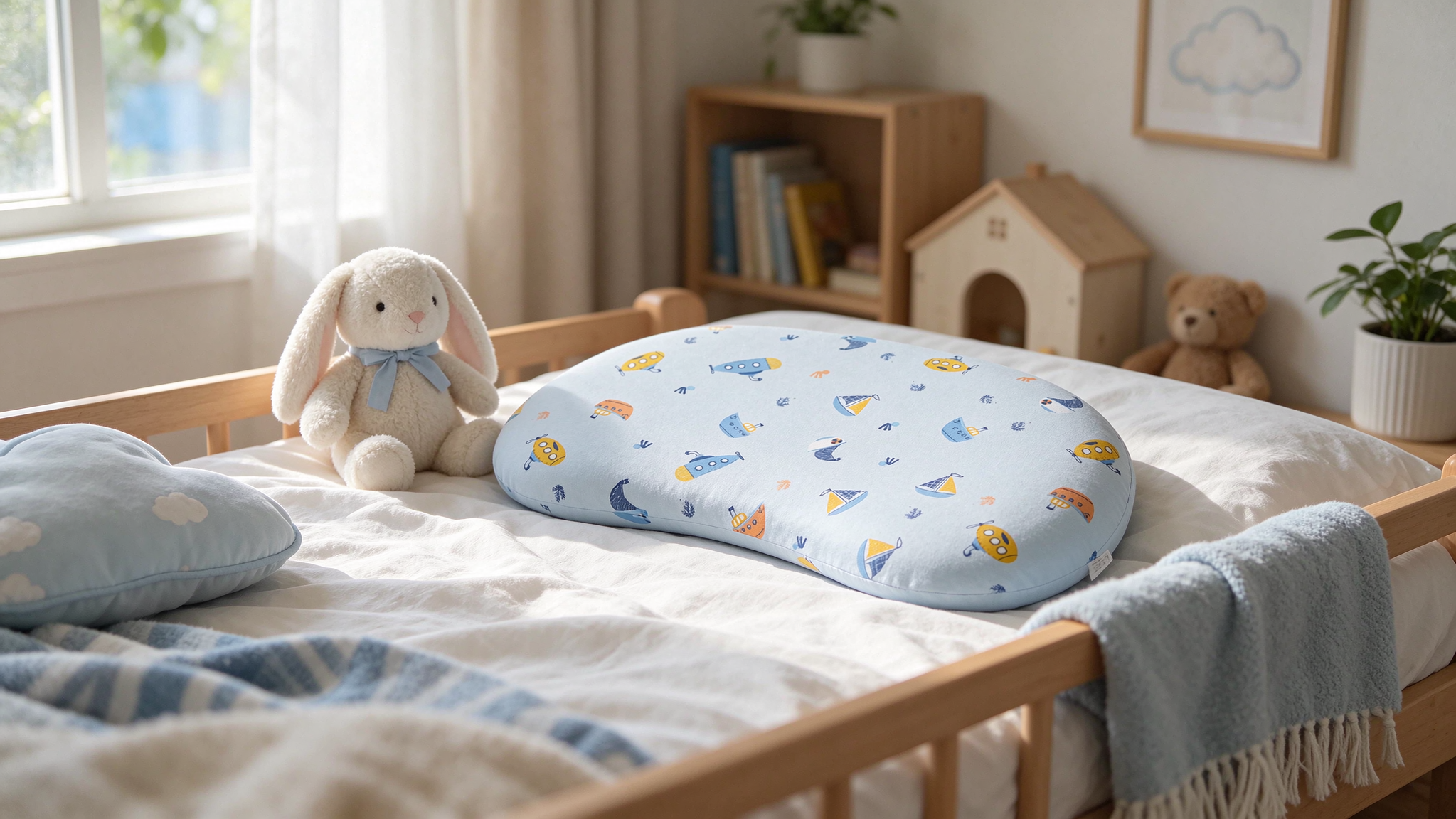
A printed kids' pillow on a child's bed, with the cloud-shaped companion alongside: the set a listing photographs long before a specification is written.
The listing as a specification
A pillow listing is unusually information-dense. Reviews mention height and firmness long before they mention colour; return reasons cluster around the same two variables; the questions section asks whether the cover can be removed and whether the core can be washed. Read together, a listing tells a brand three things it would otherwise learn after launch: which age band the product is actually bought for, which support structure survives shipping and daily use, and which cleaning promise the buyer expects to be true.
That is why the brief for the zoned-support kids' pillow began with structure rather than with appearance. The client needed zoned support tailored to a target age group, a soft core with good resilience, dimensions and height adjusted for the intended users, a construction that could be washed as a whole, and reliable supply for volume production. The answer was not a generic children's pillow with a new print: the zone layout, the dimensions, the support height and the silicone firmness were adjusted together, and the client confirmed feel, appearance and use experience on samples before production went ahead under the approved specification.
The cloud pillow project followed the same route from a different starting point. There the requirements were a soft, resilient silicone core, size and height tailored to the intended users, washability for everyday care, and — the item that decides whether a bestseller stays a bestseller — consistent dimensions and firmness in volume production. Dimensions, support height, appearance and silicone firmness were refined against the target users and the sales channel, and the project moved into volume production only after feel, colours, user experience and packaging presentation had been confirmed.
Project What the client specified Listing as displayed Zoned-support kids' pillow Age-specific zone layout; soft resilient core; size and height per age group; fully washable; volume supply 20K+ units sold; store above 95% of peer stores Kids' cloud pillow Soft resilient core; size and height for intended users; washable; stable dimensions and firmness in volume 100K+ units sold; 200K+ cart adds; 10K+ purchases in 30 days; No. 1 on the displayed list Source: marketplace screenshots supplied by the client, dated 15 September 2026. Figures reflect the page display at that date and may change. What the numbers actually buy
Volume changes the manufacturing question. A sample that feels right in a buyer's hands is a prototype problem; a product that has to hold the same feel across tens of thousands of units is a process problem. Two failure modes account for most of the difference.
The first is dimensional drift. When a pillow's height or contour shifts by a few millimetres between batches, the listing's photographs and its reviews start to disagree with what arrives in the box, and the return rate moves before anyone has changed the design. The second is firmness drift. Silicone firmness is the variable buyers describe with words like "too soft" or "too hard", and it is the variable least visible in a factory's own records unless the approved sample and the written specification are used as the reference for every batch.
Both cases above ended in the same place: an approved specification that covers dimensions, shape, firmness, colour, surface structure, grooves or ventilation holes, and packaging, with the near-universal expectation that the core can be washed. Zhenpeng's own product line reflects that expectation — baby, kids' and adult silicone pillows, ergonomic and neck support pillows, 4D breathable pillow cores and fully washable silicone pillows — and the 12,000 m² plant in Yancheng, Jiangsu, runs development, moulding, inspection and packing as one sequence rather than as separate services.
Where customisation has to stop
A listing-driven brief tempts a brand to customise everything at once. The practical limit is the sample: every change to size, contour, zone layout, groove position, vent pattern, firmness, colour or cover moves the mould, the artwork or both, and each of those has to be re-approved. Projects move faster when the changes are grouped — one structural round, then one colour and packaging round — than when they are released one at a time.
The areas that can be customised in a silicone pillow programme are consistent across both cases: size and shape, high-low contours, grooves, ventilation holes, firmness, material specification, colour and surface texture; and, at the finished-product level, plain or printed covers, labels, instruction cards, private-label packaging and shipping cartons, with artwork supplied or approved by the customer. What cannot be promised is a claim: suitability and any product statement belong to the brand and have to be verified for the market where the listing runs.
The specification a listing-driven project needs
Brands that have already read their channel data can usually fill this in before the first sample:
-
The age band or user group the listing actually sells to, and the size and height ladder that follows from it.
-
Support structure: flat, contoured, zoned, grooved or perforated, with the zone or groove layout drawn rather than described.
-
Firmness target and the tolerance the brand will accept batch to batch, referenced to an approved sample.
-
Whether the whole pillow must be washable, and what the cover and label have to survive.
-
Colour set and cover artwork, supplied with print-ready files and the packaging dimensions.
-
The volume expectation per model per year, and the models that share colours, covers or cartons so the range does not multiply its own complexity.
-
The documents the brand's own marketplace or retail channel requires before the listing goes live.
Read in that order, a marketplace page stops being a marketing artefact and becomes the front end of a manufacturing specification. The commercial value of the two projects above is not the sales figure itself; it is that the figure was reached with a specification the plant could repeat.
Alongside its product work, Zhenpeng holds a set of AAA-rated credit and integrity recognitions covering corporate credit, contract performance, quality and service, and supplier credibility — a commercial record that matters to buyers placing repeat volume orders rather than one-off samples.
Product ranges, customisation scope and the sample route are published at http://www.zpsilipillow.com. Yancheng Zhenpeng New Materials Co., Ltd., Yancheng, Jiangsu, China.
http://www.zpsilipillow.com
Yancheng Zhenpeng New Materials Co., Ltd. -
-
AuthorPosts

- You must be logged in to reply to this topic.