- This topic is empty.
-
AuthorPosts
-
2026-09-16 at 3:59 pm #11335
Choosing an epoxy acrylate for a UV coating is not simply a matter of selecting the hardest or fastest-curing resin. The right choice depends on the substrate, coating process, curing conditions, required film properties, and overall formulation cost. Epoxy acrylate should therefore be evaluated as part of the complete UV coating system rather than as an isolated raw material.
1. What should I consider first when choosing an epoxy acrylate?
Start with the application and substrate. A UV coating for wood flooring has different requirements from one used for plastic parts, UV inks, or vacuum metallization.
Key factors usually include:
-
Resin viscosity and processability
-
Curing speed and compatibility with the UV/LED curing system
-
Hardness and flexibility
-
Adhesion to the substrate
-
Gloss and surface appearance
-
Scratch and abrasion resistance
-
Chemical and water resistance
-
Cost and formulation efficiency
For example, a resin designed for a hard protective coating may not be the best option when flexibility or adhesion is the primary requirement.
2. Is higher hardness always better?
No. High hardness can improve scratch resistance and surface durability, but excessive hardness may reduce flexibility or create adhesion problems on certain substrates.
For wood, PVC, SPC flooring, and decorative surfaces, the formulation may need a balance between hardness, flexibility, adhesion, leveling, and appearance. The final film properties are also affected by reactive monomers, photoinitiators, additives, coating thickness, and curing conditions.
This is why resin selection should be based on the required performance profile rather than a single TDS value.
3. How important is viscosity?
Viscosity can have a major impact on formulation and application. Lower-viscosity epoxy acrylates can be useful for applications such as UV inks, where flow, pigment wetting, printing stability, and processing behavior are important.
For applications requiring higher curing efficiency, a low-viscosity epoxy acrylate may also help reduce the amount of reactive diluent needed. For example, Lencolo L-6111 is a low-viscosity UV epoxy acrylate designed for UV ink applications including inkjet, screen, flexographic, and offset printing, where curing performance is an important consideration.
However, viscosity should not be evaluated independently. A resin that is easy to process must still provide the required adhesion, hardness, flexibility, and surface performance after curing.
4. What if formulation cost is a major concern?
Look at the cost of the complete formulation rather than comparing resin prices alone. A lower-cost resin can be useful if it provides the required performance without excessive adjustment of other components.
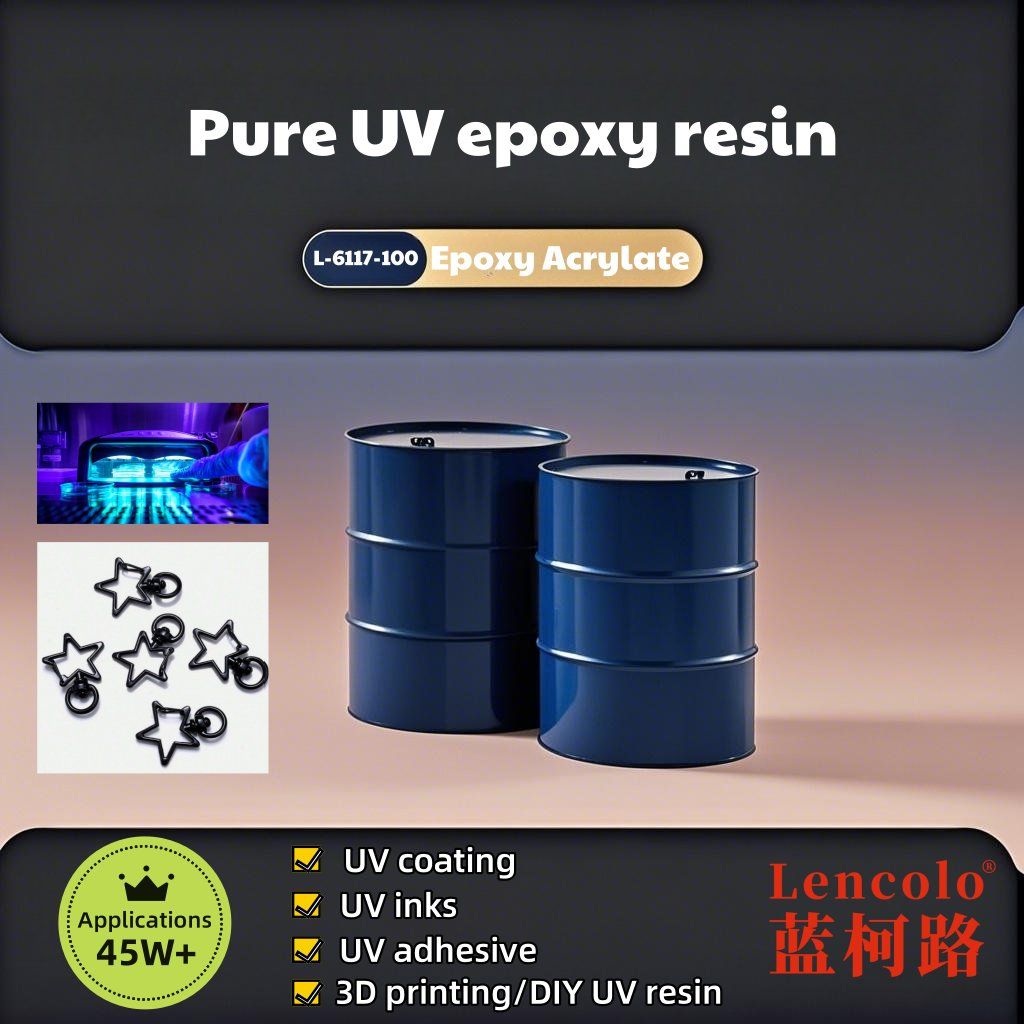
For cost-sensitive UV wood coatings, furniture coatings, PVC, and SPC flooring, Lencolo L-6112C, L-6117, and L-6118 are examples of economical UV epoxy resin options. These grades should still be tested for curing, adhesion, hardness, appearance, and compatibility with the rest of the formulation before commercial use.
5. Can epoxy acrylate be used for vacuum metallization coatings?
Yes, but the resin needs to match the specific metallization process. Vacuum metallization commonly requires good wetting, leveling, adhesion, surface smoothness, and compatibility between coating layers.
L-6117 and L-6118 can be considered for cost-sensitive vacuum metallization applications. Actual selection should be confirmed through trials because the result depends on the substrate, primer or basecoat, metal layer, topcoat, curing conditions, and coating thickness.
6. Should I evaluate the epoxy acrylate by itself?
Not if the goal is to predict finished-coating performance. UV coating performance comes from the interaction of the resin with monomers, photoinitiators, additives, pigments, substrate, coating thickness, and UV/LED equipment.
For troubleshooting problems such as poor adhesion, incomplete curing, surface defects, or insufficient hardness, changing the resin alone may not solve the issue. The entire formulation and curing process should be reviewed.
7. What should I ask an epoxy acrylate supplier?
Before selecting a grade, ask for the TDS, SDS, samples, recommended application areas, viscosity data, curing characteristics, suggested formulation range, and substrate compatibility information. It is also useful to confirm whether the supplier can provide related monomers, photoinitiators, additives, or other UV resins when formulation adjustment is required.
Lencolo, the brand of Guangdong Lencolo New Material Co., Ltd., supplies UV resins including epoxy acrylates together with UV monomers, photoinitiators, and functional additives for applications such as UV coatings, flooring, printing inks, vacuum metallization, adhesives, and other UV-curable systems.
Conclusion
There is no single epoxy acrylate that fits every UV coating application. A practical selection process starts with the substrate and application, then compares viscosity, curing behavior, hardness, flexibility, adhesion, surface performance, and cost. Sample testing under actual formulation and curing conditions remains the most reliable way to confirm whether a resin is suitable for a specific UV coating system.
https://www.lencolo37.com/
Guangdong Lencolo New Material Co., Ltd. -
-
AuthorPosts

- You must be logged in to reply to this topic.