- This topic is empty.
-
AuthorPosts
-
2026-09-16 at 3:46 pm #11317
An ultrasonic sensor is specified by three numbers that are easy to confuse: the maximum range it can reach, the blind zone directly in front of the transducer, and the repeatability it delivers at the distance actually used. Of those, the blind zone is the one frequently left out of a quotation and the one frequently responsible for a sensor that works on the bench and fails in the tank. KJT Sensors manufactures ultrasonic sensors with examination ranges from 50 mm to 6000 mm, repeat accuracy of ±0.15% of full scale, built-in temperature drift compensation, IP67 housings, and a 5-core M12 connector, together with a dedicated family for double-sheet detection.
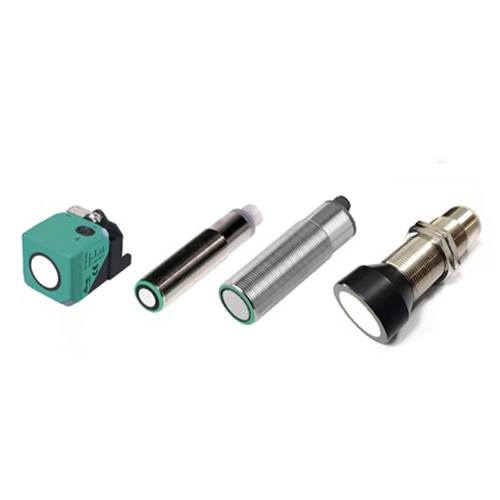
How an Ultrasonic Sensor Measures Distance
An ultrasonic sensor emits high-frequency mechanical sound waves and measures the time taken for the echo to return from the target. Distance follows from the speed of sound, so the medium carrying the sound is part of the measuring instrument.
In air at 20 °C the speed of sound is approximately 343 m/s, and it rises with temperature by roughly 0.17% per °C. Two consequences follow directly from that number.
- Temperature compensation is not optional. Without it, a 20 °C rise in ambient temperature would inflate every reading by about 3.4% — a larger error than the ±1% accuracy figure quoted for a temperature-compensated sensor.
- Air is the medium. Sound needs a gas column, which is where the technology’s tolerances and its limitations both come from. It works in dust, mist, and darkness; it does not work where there is no air.
Three practical properties make ultrasonic sensing useful where optical sensing struggles. Sound is unaffected by the color, transparency, or surface finish of the target, so transparent bottles, dark rubber, and bare metal reflect alike. It is unaffected by the target’s reflectivity in the optical sense, which means a matte black surface is no harder to detect than a white one. And it is unaffected by airborne dust and water mist in the beam path, which is exactly the condition that degrades a photoelectric reading.
The KJT ultrasonic family carries built-in temperature drift compensation and is specified at ±1% accuracy on the compensated models, which is the basis for using it as a level instrument rather than only as a presence detector.
Range, Blind Zone, and Resolution: Three Numbers That Decide the Model
The KJT ultrasonic range ladder is arranged in two body classes, with the family designation reflecting the barrel size.
- Compact family — examination ranges of 50 mm, 150 mm, 300 mm, 500 mm, and 1000 mm.
- Larger family — examination ranges of 1500 mm, 2000 mm, 4000 mm, and 6000 mm.
- Double-sheet detection models — a separate group of compact sensors built for stack discrimination rather than for distance output.
The published specification of a 1500 mm model shows how the three numbers fit together: examination range 80 to 1500 mm, blind area 0 to 80 mm, resolution 0.17 mm, repeat accuracy ±0.15% of full scale, response time 80 ms, switching frequency 12.5 Hz, hysteresis ±2 mm, and power-on delay under 500 ms.
Reading those figures against an application produces three selection rules.
- The blind zone is a mounting constraint, not a detail. A 1500 mm model cannot measure anything closer than 80 mm, so the highest surface the tank will ever reach has to stay beyond that distance. Where a full tank approaches the transducer, a longer-range model is the wrong answer — a shorter-range model with a smaller blind zone is the right one.
- Repeatability scales with the range class. At ±0.15% of full scale, a 1500 mm model repeats to about ±2.25 mm and a 500 mm model to about ±0.75 mm. Specifying a 6 m model to cover a 300 mm span gives up a factor of twenty in repeatability for range the application does not use.
- Resolution and accuracy are different promises. A 0.17 mm resolution describes the smallest change the electronics can report; the ±0.15% repeat accuracy describes how reliably that change means something. An application that needs 1 mm of certainty is served by both figures, and one that needs 0.1 mm is served by neither.
Level Measurement in Tanks, Hoppers, and Open Channels
Non-contact level measurement is the mainstream use of the technology, and it asks for four things to be settled in order.
- Mounting height against the blind zone. The transducer is normally mounted vertically above the surface, and the mounting height has to place the empty and full surfaces inside the examination range with room for the blind zone at the top. Measurement is usually configured so that the reading is reported as level rather than as distance.
- Signal output. Level is a continuous value, so the installation normally needs an analog or digital signal rather than a switched threshold. Where the KJT sensor is used as a switching point — a high-level alarm, a pump stop, a low-level interlock — the 12.5 Hz switching frequency and 80 ms response time on the 1500 mm model are fast enough for control and slow enough to ignore surface ripples.
- Media that absorb or scatter sound. Foam on the surface absorbs the echo, and a liquid that generates heavy vapor changes the acoustic path. Where foam is unavoidable, mounting the sensor in a stilling well, moving the measuring point away from the foam line, or selecting a radar instrument for the same tag solves the problem more reliably than changing the ultrasonic model.
- Vessel geometry. Internal ladders, agitators, and tank walls reflect sound sideways and produce false echoes. Aiming the sensor away from structural features, and using the setup mode that recognizes all objects between the sensor and the taught background, is the practical mitigation.
Water treatment, chemical, food, and pharmaceutical installations are the natural home for this combination, because the vessels are usually moderate in depth, the medium is often transparent or colorless, and the sensor stays clear of the product. A water utility uses KJT instrumentation for supply network flow metering and clear-water tank level monitoring, with 4-20 mA signals brought directly into SCADA, a configuration that suits both the ultrasonic level sensors and the company’s static-pressure level and electromagnetic flow families.
Double-Sheet Detection in Sheet Metal, Foil, and Paper Handling
Double-sheet detection is the application where ultrasonic sensing has no direct optical substitute.
A press feed, a printing press, a foil unwind, or a can body line has to know whether the gripper is holding one sheet or two before the machine closes. Optical sensors cannot answer that question on the same surface, because the top sheet and the top sheet of a double look identical from above. Ultrasonic sensing answers it acoustically: the sound energy transmitted through the stack depends on how many layers it contains, so the sensor distinguishes one sheet from two without any optical contrast to rely on.
KJT manufactures a dedicated group of double-sheet detection ultrasonic sensors in this class, which means the application does not need a general-purpose proximity sensor pressed into a job it was not designed for. Four practical details decide whether the detection is reliable:
- Sheet material and thickness range. The transmitted energy depends on the material and the gauge, so the specification has to be quoted for the actual sheet, not for a reference sample.
- Air gap and clamping. The sensor face and the sheet have to hold a repeatable distance; a floating sheet under a light hold-down gives inconsistent results.
- Teach-in. The teach function establishes the one-sheet and two-sheet references on the actual stack the machine runs, which is faster and more reliable than setting a threshold from the datasheet.
- Machine reaction time. Detection has to happen before the press closes, so the 80 ms response time and 12.5 Hz switching frequency of the compact models need to be checked against the machine’s cycle.
Where Ultrasonic Sensors Win Over Optical Sensing
The technology earns its place in a specific set of conditions rather than in general.
- Transparent targets. Bottles, film, glass, and clear liquid do not reliably interrupt a light beam and do not return a consistent reflection. Sound reflects from the surface regardless of transparency.
- Dark, matte, and mixed-color targets. A line that runs black parts alongside white ones gives an optical sensor two very different signal levels. Ultrasonic sensing gives one.
- Dirty and misty environments. Dust, water mist, and coolant vapor in the beam path degrade an optical signal and leave an acoustic one largely intact. This is the case the KJT ultrasonic range is specified for.
- Washdown and food areas where non-contact matters. No contact with the product, no geometry to trap material, and no optical window to be obscured by product residue.
Where Ultrasonic Sensors Struggle
Honest specification includes the conditions that rule the technology out, and they are all acoustic rather than electrical.
- Vacuum and very low pressure. Sound needs a gas column, so ultrasonic sensing does not work in a vacuum vessel.
- Foam layers and heavy surface turbulence. Both destroy the echo path.
- Steam and strong temperature gradients. A steep temperature gradient bends the sound path; a large vessel with a hot surface and a cold top can produce a measurement that wanders without any process change.
- Sound-absorbing materials. Soft, porous, and fibrous surfaces — cloth, foam, sawdust, insulation — absorb rather than reflect, which reduces the returned energy.
- Strong air movement. Forced ventilation and open doors create air currents that shift the acoustic path.
- Range limits. Beyond roughly 6 m in this family, and in dust-laden or humid atmospheres, radar becomes the better instrument for the same measuring task.
Synchronization and Multi-Sensor Installations
Ultrasonic sensors in the same area can hear each other, and an echo from a neighbouring sensor is indistinguishable from a real target echo unless the installation manages it.
The KJT ultrasonic models include a synchronization function and support multi-channel operation, which coordinates the emissions of adjacent sensors so that they do not measure during a neighbour’s listening window. Three installation practices make the difference in the field:
- Synchronize or sequence. Physically separating sensors helps, but synchronization is the reliable method where several devices look into the same space.
- Keep beam cones apart. The acoustic cone widens with distance, so two sensors mounted metres apart can still overlap at the far end of their ranges.
- Stagger the mounting heights. Two sensors aimed at the same surface from different heights are less likely to interfere than two at the same level.
A related benefit of the synchronization feature is coverage: several synchronized sensors can supervise a wide area at a lower cost than one long-range device, which is the standard approach to area monitoring with ultrasonic sensing.
Outputs, Housing, and Electrical Details
The electrical characteristics of a level or detection sensor determine how it integrates, and the KJT ultrasonic models are specified in the range typical for industrial ultrasonic sensing.
- Supply and load. 10 to 30 V DC with a minimum of 12 V under load, load impedance of ≤300 Ω for current output and >1 kΩ for voltage output, no-load current ≤30 mA, and voltage drop ≤2 V.
- Protection. Overload protection at 200 mA with both indicator LEDs flashing, plus short-circuit protected outputs and automatic reset.
- Reliability over time. The overload and no-load figures matter in installations where several sensors share a supply rail and a single fault would otherwise take down a group.
- Housing and connection. Nickel-plated copper sleeve with plastic fittings and glass-filled epoxy resin potting, IP67 protection, and a 5-core M12 connector — a combination that tolerates dust and water jet on the plant floor.
- Environment. Ambient temperature −25 °C to +70 °C, storage −40 °C to +85 °C, with the internal temperature compensation covering the operating band.
- Indication and setup. Red and green LEDs report target state and teaching status, and the sensors support offline parameter setting on a display, which allows a batch of units to be pre-configured before installation and keeps commissioning time off the critical path.
Cross-Referencing an Installed Ultrasonic Sensor
Replacing an ultrasonic sensor in an existing machine is a mechanical and acoustic exercise rather than an electrical one.
- Barrel size and thread. Compact industrial ultrasonic sensors are standardized enough in barrel and thread that cross-referencing across brands is practical, but the sensing face diameter and the housing length are not always identical even when the thread matches, and the acoustic behaviour follows the face diameter.
- Examination range and blind zone. Both have to be inside the existing mounting geometry. A replacement with a longer range usually brings a larger blind zone, which can put a full tank inside the dead band.
- Output and connector. Match the switching function, the output type, and the 5-core M12 pin assignment against the existing cable run.
- Teaching method. If the installed device was set up with a teach function, the replacement has to offer the same method for the maintenance team to keep the reference points they rely on.
- Target material. The teach reference has to be re-established on the actual material, not copied from the previous installation.
Where KJT Sensors Fits
KJT Sensors is the international brand of Nanjing KJT Electric Co., Ltd., an industrial sensor manufacturer established in 2010. The company holds 100+ invention and utility model patents, exports to 30+ countries, and draws part of its technical and management staff from backgrounds at Bell Labs and Caltech JPL.
Compliance coverage includes ISO 9001, ISO 14001, and ISO 45001 management system certification, product certification to CE, RoHS, CCC, and SIL, and explosion protection through the Explosion-proof Certificate, ATEX, and IECEx. Enclosure protection across the product range spans IP65, IP67, IP68, and IP69K.
Ultrasonic sensing sits inside a wider non-contact measurement portfolio at KJT that includes radar level meters, laser distance and displacement sensors, electromagnetic flow meters, and static-pressure level transmitters — which means a tank farm with a mix of clean liquids, dusty solids, and foaming process streams can be specified from one catalogue instead of three. A water utility uses KJT instrumentation for supply network flow metering and clear-water tank level monitoring, with 4-20 mA outputs brought directly into SCADA — the integration chain that level instrumentation is typically bought to serve.
https://www.kjt-sensors.com/
KJT Sensors -
AuthorPosts

- You must be logged in to reply to this topic.