- This topic is empty.
-
AuthorPosts
-
2026-11-11 at 4:36 pm #13044
Published: November 11, 2026 | By SWOTO Engineering Team
Neutron shielding clothing does not block radiation the way a lead apron blocks X-rays: it slows neutrons first, then absorbs them, and the ≥60% on a spec sheet applies only to thermal-neutron fields and only to the panels it covers. That distinction belongs in the purchase order. Understanding how boron carbide and HDPE work in neutron shielding clothing explains why a 99% figure from a shielding-board datasheet cannot be compared with a garment claim, and why a vest-and-cap set is never whole-body protection. SWOTO, a China manufacturer with OEM/ODM support for nuclear PPE, publishes ≥60% front-and-rear thermal neutron shielding for its vest-and-cap set rather than a rounded-up material number. Below: the two-step physics, the test geometry any percentage must state, and the documents to request.
1. How do boron carbide and a hydrogen-rich polymer actually stop a neutron?
Two separate jobs: hydrogen slows the neutron, boron-10 removes it, and neither step works on an unmoderated fast-neutron field with a few millimetres of fabric. Hydrogen nuclei have almost the same mass as a neutron, so elastic scattering removes a large fraction of its energy per collision. Once thermalised — around 0.025 eV — B-10 has a thermal absorption cross section of roughly 3,837 barn (a 2020 International Journal of Radiation Research review gives ~3,838 barn), and the 10B(n,α)7Li reaction ends the neutron's life.
Energy range is the first filter. ISO 8529 reference fields use Am-Be at ~4.4 MeV mean, Cf-252 at ~2.1 MeV and D-T at 14.1 MeV; slowing those neutrons takes centimetres of hydrogenous material, not a wearable liner. A garment assumes the facility has already moderated the field — reactor thermal columns, beamline end stations, BNCT suites and neutron source handling.
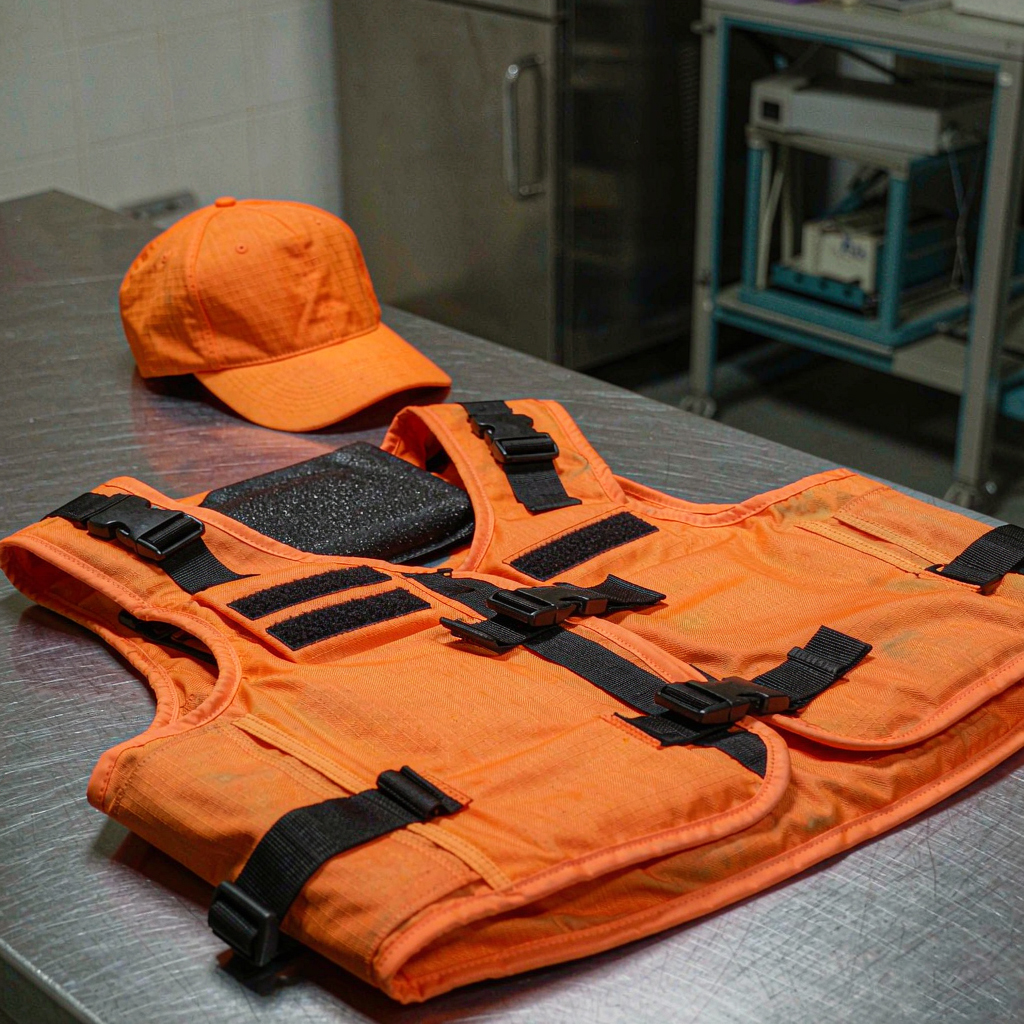
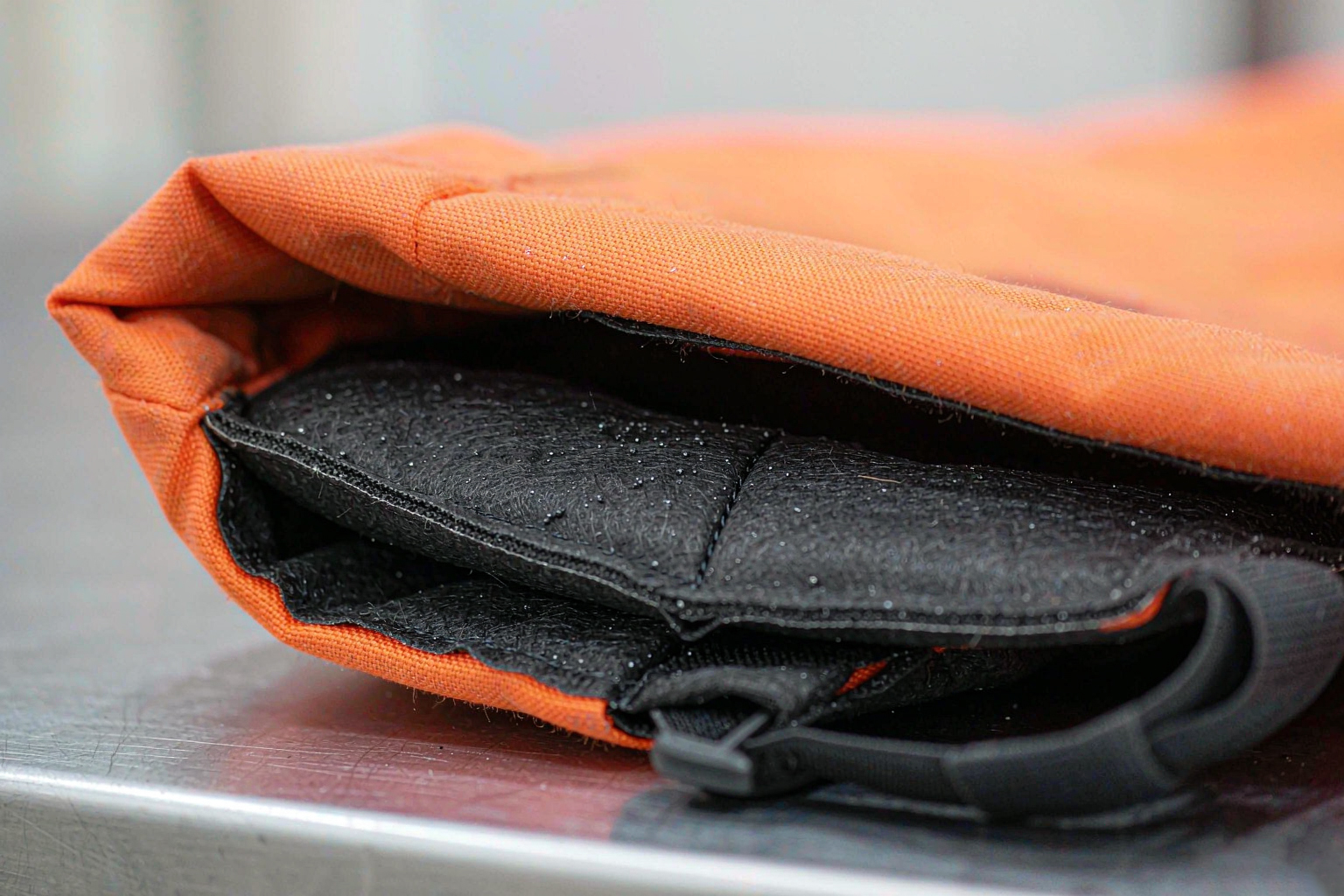
Material wording gets slippery here. Rigid boards are usually HDPE or borated polyethylene; SWOTO uses a hydrogen-rich polypropylene/B4C sheath-core composite non-woven instead. Both are polyolefins and moderate by the same hydrogen-scattering mechanism, but a fibre liner can be heat-sealed, detached, cleaned and replaced. So boron carbide versus borated polyethylene for neutron shielding clothing is not a contest between absorbers — it is a choice between a flexible replaceable liner and a rigid panel. The liner carries ≥30% B4C by content, under an orange antistatic polyester-polypropylene outer layer that blocks radioactive dust; the whole vest-and-cap set weighs ≤2.0 kg.
That ≥30% is filler content, not 30% attenuation, and more boron is not automatically better. Laboratory guidance puts useful natural-boron loading for fission-spectrum shields at 1–5 wt%; up to 30 wt% is reserved for space-limited designs because excess boron displaces hydrogen, causes self-shielding in the absorber particles and degrades mechanical properties. Any supplier explaining how boron carbide and HDPE work in neutron shielding clothing should state layer thicknesses in mm and the hydrogen-to-boron balance, not just a headline percentage.
Two more facts belong in the hazard assessment. Capture is not radiation-free: B-10 emits a 0.478 MeV prompt gamma in ~94% of captures, and hydrogen capture produces 2.223 MeV. Mixed fields need a separate photon shield — the site's lead-free tungsten-bismuth vest is rated in lead equivalence (≥0.25 mmPb, up to 0.5 mmPb), a photon unit that says nothing about neutrons. And EN 1073-2, the standard most buyers cite for nuclear coveralls, covers particulate radioactive contamination only, not ionising radiation itself. Those are different products in the SWOTO nuclear radiation protective range; one line item cannot cover both hazards.
✅ Bottom line: Moderation needs hydrogen, capture needs boron-10, and neither step shields an unmoderated fast-neutron field with a few millimetres of fabric.
2. What does ≥60% really certify, and why is 99% a different number?
≥60% is a panel-level thermal-neutron shielding rate on the front and rear of a worn vest-and-cap set; the 99% figures in procurement almost always come from 20–30 cm rigid borated polyethylene boards in a collimated beam. Published board data make the gap concrete: at 8% boron loading, 10 cm gives 82.5% against Am-Be and 90.9% against Cf-252; 20 cm gives 95.6% and 97.8%; 30 cm reaches 98.2% and 99.3%. Thickness dominates. When a quotation describes a neutron shielding suit with 99 percent thermal neutron attenuation, ask for the source, geometry and sample thickness first.
Geometry alone can move the number by double digits. Narrow-beam (good geometry) transmission sees only uncollided neutrons and yields a material property; broad-beam (poor geometry) includes scattered and room-return neutrons and reports realistic dose attenuation, always lower. Engineering acceptance needs broad-beam data. The report must also name the measured quantity: fluence rate, or ambient dose equivalent H*(10) with a rem counter under IEC 61005 and ICRP 74 coefficients. Bare and cadmium-covered gold foils (ASTM E261/E262 practice) separate thermal from epithermal response; ISO 14152 covers shielding-material selection.
Watch a second ambiguity. SWOTO publishes two different ≥60% figures: the neutron suit's thermal neutron shielding rate on front and rear panels, and a ≥60% X/gamma protection efficiency on key areas of its lead-free full-body suit (≥30% elsewhere). The tungsten-bismuth vest is quoted in mmPb lead equivalence. Three products, three units, three hazards. Published board data make boron carbide versus borated polyethylene for neutron shielding clothing a thickness-and-geometry question, not an ingredient question — which is why the unit belongs in the spec line.
Coverage is the third number buyers forget. The vest-plus-cap set protects chest, abdomen and neck, and is stated as applicable only to thermal neutron working environments; limbs, head sides and back are outside the shielded area. A 60% reduction over part of the trunk is not a 60% whole-body dose reduction. Put a per-size coverage map in the tender alongside personal dosimetry and time-distance controls.
Before sign-off, request this set from any supplier:
• Source term and neutron energy spectrum, with the ISO 8529 reference field identified.
• Narrow-beam or broad-beam geometry, with scatter and room-return correction.
• Measured quantity — fluence or H*(10) — plus instrument type and calibration.
• Flat swatch or finished garment, with results per size and per shielded panel.
• B4C content and areal-density uniformity, including XRF, ICP or CT checks for filler agglomeration.
• Secondary gamma dose behind the assembly: the 0.478 MeV boron line and 2.223 MeV hydrogen line.
• Retest data after the specified decontamination and wash cycles — a detachable liner is reusable only if its shielding survives cleaning.
✅ Bottom line: A shielding percentage is meaningless without the source spectrum, beam geometry, measured quantity and the body area it covers.
Frequently Asked Questions
Q: Can I write a single shielding percentage into a tender?
A: No. A defensible tender separates moderation from capture, so reviewers should first confirm how boron carbide and HDPE work in neutron shielding clothing, then require the test geometry, measured quantity and a per-size coverage map. SWOTO supplies model-by-model and size-by-size test documentation for verification rather than one rounded claim.
Q: Is a neutron shielding suit with 99 percent thermal neutron attenuation suitable for fast-neutron work?
A: No. That 99% normally describes a thick rigid board under a collimated thermal beam. A flexible vest assumes an already-thermalised field and covers the trunk only. For Am-Be, Cf-252 or D-T fields, facility shielding, distance and stay time remain the primary controls; SWOTO states thermal-neutron-only use on the product page.
Q: Do you support OEM/ODM sizing and bulk documentation?
A: Yes. SWOTO Protection Technology Co., Ltd. builds the vest-and-cap set in multiple sizes with detachable, independently replaceable heat-sealed liners, and supports OEM/ODM configurations for research reactors, neutron sources and BNCT facilities. Ask our factory for the documentation pack before a bulk order, including liner replacement intervals and the retest schedule after decontamination.
Next Step: Get a Free Specification Check
Send your source term, neutron spectrum, dose quantity and required coverage to the SWOTO engineering team. We will return a free spec-check sheet mapping your field conditions to the right configuration, plus model-by-model and size-by-size test reports for supplier review — the same pack our QA team uses before a neutron radiation protective suit ships.
As a China manufacturer with OEM/ODM capability, SWOTO Protection Technology Co., Ltd. can also quote liner areal density, size runs and replacement schedules for long-term maintenance planning. SWOTO works with PPE distributors on wholesale supply; contact our engineering team with your target market and required test standards.
http://www.swotoglobal.com
SWOTO Protection Technology Co., Ltd. -
AuthorPosts

- You must be logged in to reply to this topic.