- This topic is empty.
-
AuthorPosts
-
2026-10-30 at 8:16 pm #12717
Same Part, Two Numbers: Self-Limiting PTC Heaters
One heater, two power figures. Model 6578 draws 1,000 W in airflow and about 100 W when the airflow stops — a stalled fan, a blocked duct, a unit installed the wrong way round. Nothing trips, nothing burns; the element simply stops asking for power.
That behaviour is the whole argument for PTC ceramic heating inside an enclosure, and it is easiest to see on a single part number.
What the two numbers mean
PTC ceramic raises its resistance as it heats. Driven at a fixed voltage, the current falls away, so power drops instead of climbing. In airflow the element stays cool and powerful; starve it of air and it settles into a low, self-limited output.
The consequence matters more than the physics: there is no red-hot element and no thermal runaway at dry burn, so a failed fan turns a 1,000 W heater into a 100 W one rather than into a fire risk.
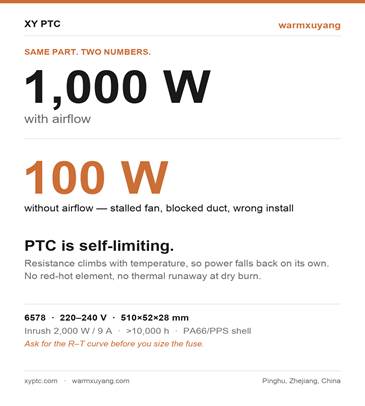
Model 6578 at 220–240 V: 1,000 W with airflow, roughly 100 W without. The drop is the safety feature, not a fault.
Size the fuse for the cold element
The same characteristic that makes the heater safe makes it awkward to switch. A cold PTC element has its lowest resistance at the instant of switch-on, so 6578 shows an inrush of 2,000 W / 9 A — roughly twice its running power. Fuses, relays and contactors have to be rated against that peak rather than the steady-state figure, which is a common source of nuisance trips in the field.
For that reason the R–T curve is the first document we send: it shows how power falls with temperature and lets the electrical and thermal designs be sized in one pass.
Five families, 28 models
The range is organised around five constructions, because enclosures differ more than heaters do.
· Aluminum shell (6217) — 60 W dry, 300 W in airflow, 70 × 68 × 7 mm; thin profile for tight cabinet walls
· Conductive PTC (1983) — 1,500 W in a PA66 frame with no insulation layer, for earthed enclosures that want direct heat transfer
· Fan heater (6760) — 200 W, heater and fan in one unit, for forced convection in sealed cabinets
· Insulated PTC (6439) — 3,000 W with 750 V withstand, for humid and water-adjacent installations
· Liquid heater (6806) — 300 W inside a Ø25 mm steel tube, for water and coolant loops
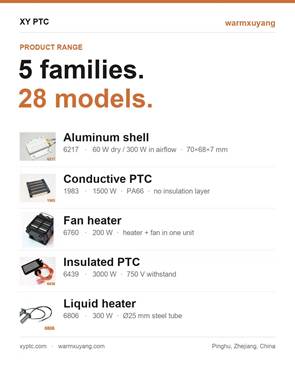
Five families, 28 models — aluminum shell, conductive, fan, insulated and liquid. Power figures are quoted dry or in airflow, never interchangeably.
Matching a family to the enclosure
Start from the enclosure rather than the heater. A sealed, earthed cabinet with a fan path usually suits the aluminum-shell or conductive type; a plastic housing that cannot be earthed pushes you toward the insulated version; a tank or a coolant loop needs the tube heater. Where airflow exists, quote power in airflow — where it does not, quote the dry figure. Mixing the two is the most common specification error we see.
Where these heaters end up
The same five constructions cover a wide spread of products: cabinet heating in energy storage, switchgear and telecom enclosures; appliance heating in egg steamers, hair tools and glue guns; air heating inside ducts and fan-driven housings; and liquid heating in tanks and coolant loops. What changes between them is the enclosure, not the principle.
Life, materials and custom builds
Every model in the range is rated for more than 10,000 hours of service. Shells are PA66 or PPS depending on how hot the application runs for how long, and terminals, lead lengths and brackets are specified per project rather than assumed.
Because the range runs from 60 W to 3,000 W across five constructions, custom work usually starts from an existing family instead of a blank sheet — a different voltage window, a longer element, a bracket that clears a cable duct.
What to send us
Three details are enough for a first pass: the supply voltage, the enclosure volume or surface area, and whether the installation has directed airflow. Add the ambient range and the duty cycle and the electrical protection can be designed in the same exchange.
Ask for the R–T curve and a quotation — send your application, voltage and airflow conditions, and we will come back with the model and the protection ratings.
https://www.warmxuyang.com/
Pinghu Xuyang Electronic Technology Co., LTD -
AuthorPosts

- You must be logged in to reply to this topic.