- This topic is empty.
-
AuthorPosts
-
2026-09-07 at 2:59 pm #10992
Selecting the right partner for small-batch trial production is one of the most consequential decisions a company makes during new product development. Before committing to full-scale mass production, businesses need a supplier that can validate design, structure, and market fit at a manageable cost—without exposing the brand to quality failures, wasted capital, or intellectual property risk. This guide breaks down the criteria that matter most when evaluating a small-batch production supplier, drawing on the integrated manufacturing model developed by Foshan Mogen Intelligent Technology Co., Ltd., an innovation-driven manufacturing enterprise headquartered in Foshan, Guangdong, China.
Why Small-Batch Trial Production Matters
New product development projects routinely run into the same set of problems: designs that are too complex to realize, too expensive to produce, or too subjective to connect with actual market demand. Many clients hesitate to commit to full-scale production because they worry about sluggish sales and sunk costs, and quality risks that surface late in development can lead to costly setbacks. Small-batch trial production exists precisely to address these concerns. It allows a company to validate product processes, structural integrity, and supply chain stability through one or more rounds of limited-run manufacturing before committing to mass production, reducing trial-and-error risk at a reasonable cost.
Key Criteria for Choosing a Small-Batch Production Supplier
When evaluating potential partners, several dimensions of capability determine whether a supplier can genuinely reduce risk rather than simply shift it downstream.

Manufacturing Equipment Suited to Limited Runs
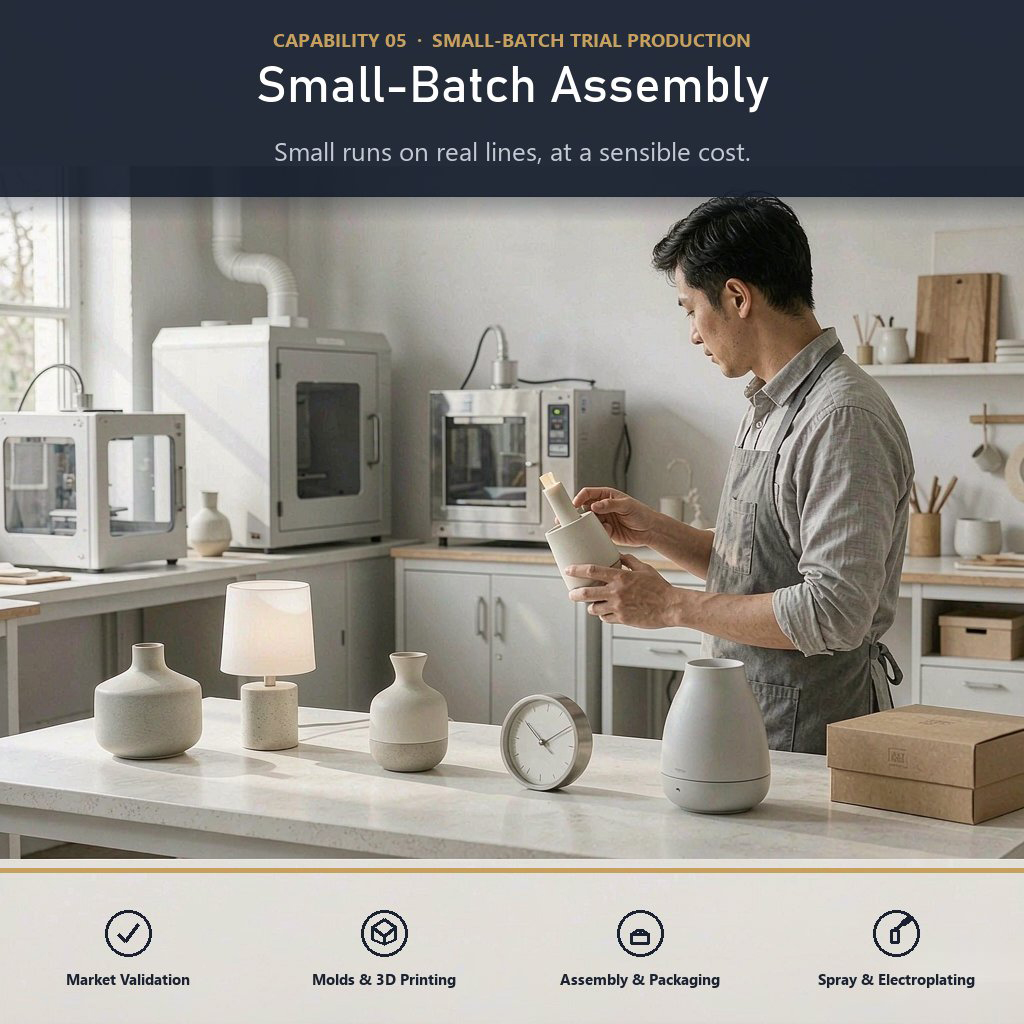
A supplier capable of small-batch production should maintain compact molds and 3D printing capacity specifically for limited runs, rather than relying solely on full-scale mass production tooling. This equipment allows a small number of units to be produced economically, without forcing clients into the cost structure of a full production line before the design has been validated. Dedicated small assembly and packaging lines are equally important, since they let a supplier replicate the finished-product experience—including packaging—at limited volume.
Dedicated Finishing Lines
Finishing processes such as spray painting and electroplating are often where cosmetic and durability issues first appear. Suppliers that operate dedicated spray-painting and electroplating lines for trial runs, separate from their main production infrastructure, are better positioned to fine-tune finish quality before it is locked into a mass-production process.
Integrated Upstream and Downstream Supply Chain
A small-batch order is only as reliable as the supply chain behind it. A supplier with an integrated network of upstream and downstream suppliers and supporting service providers can source materials and components at the scale a trial run requires, and can validate that this same supply chain will hold up once volumes increase for mass production.
Design-to-Manufacturing Integration
Small-batch production is most valuable when it is connected to the earlier stages of the product development lifecycle rather than treated as an isolated step. A supplier that also possesses industrial design capability—one that understands market insight alongside structural engineering, manufacturing processes, and materials—can catch issues where a design is too complex to realize, too expensive to produce, or too subjective to connect with the market, before those issues ever reach a small-batch run. Similarly, prototyping capability using processes such as 3D printing, cutting, polishing, electroplating, coloring, and spray painting allows clients to confirm look and feel with prototypes that are virtually indistinguishable from finished products, prior to committing to trial production.
Material Selection Expertise
The right supplier should bring intimate knowledge of material properties and cost profiles, offering a broad material palette for each new product development project. Correct material selection by product part and component affects tactile feel, aesthetics, and overall cost competitiveness—factors that should be assessed during small-batch validation rather than discovered after mass production has begun.
Systematic Risk Control and Quality Testing
Quality assurance is a defining criterion. A capable small-batch production supplier should apply a structured, new-product risk control framework and standardized quality management processes throughout development, not only at the mass-production stage. This is typically supported by dedicated testing facilities, which may include high- and low-temperature chambers, salt spray testers, vibration test rigs, UV exposure chambers, atomization testers, and dedicated circuit aging laboratories. Running this battery of tests during the R&D phase, before mass production, is what allows quality issues to be caught and resolved early—protecting clients from costly setbacks later in the process.
Full-Scope R&D Capability
Suppliers with full-scope, systematic product R&D—spanning software development, electronic circuitry, structural design, mold development (including metal, silicone, plate, and injection molds), and production process engineering—are better equipped to translate advanced technologies into tangible product innovations. This kind of R&D depth, often reinforced through long-term partnerships with research institutes and universities, supports a seamless transition from prototyping through small-batch validation to full-scale mass production.
Manufacturing and Process Engineering Discipline
Beyond the trial run itself, it is worth assessing whether a supplier can independently design and custom-build assembly lines, tooling, fixtures, and specialized equipment, and whether it maintains detailed product work instructions with continuous refinement. A holistic, systematic integration of product design, production processes, inspection standards, and cost control—along with proactive assessment of downstream production and inspection impact from the design phase—translates into steady improvements in yield rates and production efficiency once volumes scale.
Intellectual Property Protection
Patent infringement exposure and competitor copying represent real commercial risks during new product development. A supplier offering global patent search, technical analysis, patent filing, patent portfolio analysis, and infringement avoidance strategies adds a layer of protection that is often overlooked when selecting a small-batch production partner, but that can materially affect a product’s commercial viability.
How Foshan Mogen Intelligent Technology Fits This Framework
Foshan Mogen Intelligent Technology Co., Ltd. positions itself as an innovation-driven manufacturing enterprise that bridges the gap between design conception and full-scale mass production. Its capability system integrates industrial design, prototyping, material innovation, R&D, small-batch trial production, manufacturing, quality control, cross-industry innovation, and global patent services. For small-batch trial production specifically, the company maintains compact molds and 3D printing for limited runs, small assembly and packaging lines, dedicated spray-painting and electroplating lines, and an integrated network of upstream and downstream suppliers and supporting service providers.
The company’s broader track record includes more than 80 domestic and international patents, invention patents granted in the United States and Europe, and a history of prevailing in overseas patent litigation. Two of its shareholders rank among China’s Top 10 Industrial Designers, and the company has received multiple International iF Design Awards. Its service scope covers new product development from design to mass production—including prototyping, material innovation, R&D, small-batch trial production, and patent services—for clients across industries, including world-renowned and internationally renowned brands.
Conclusion
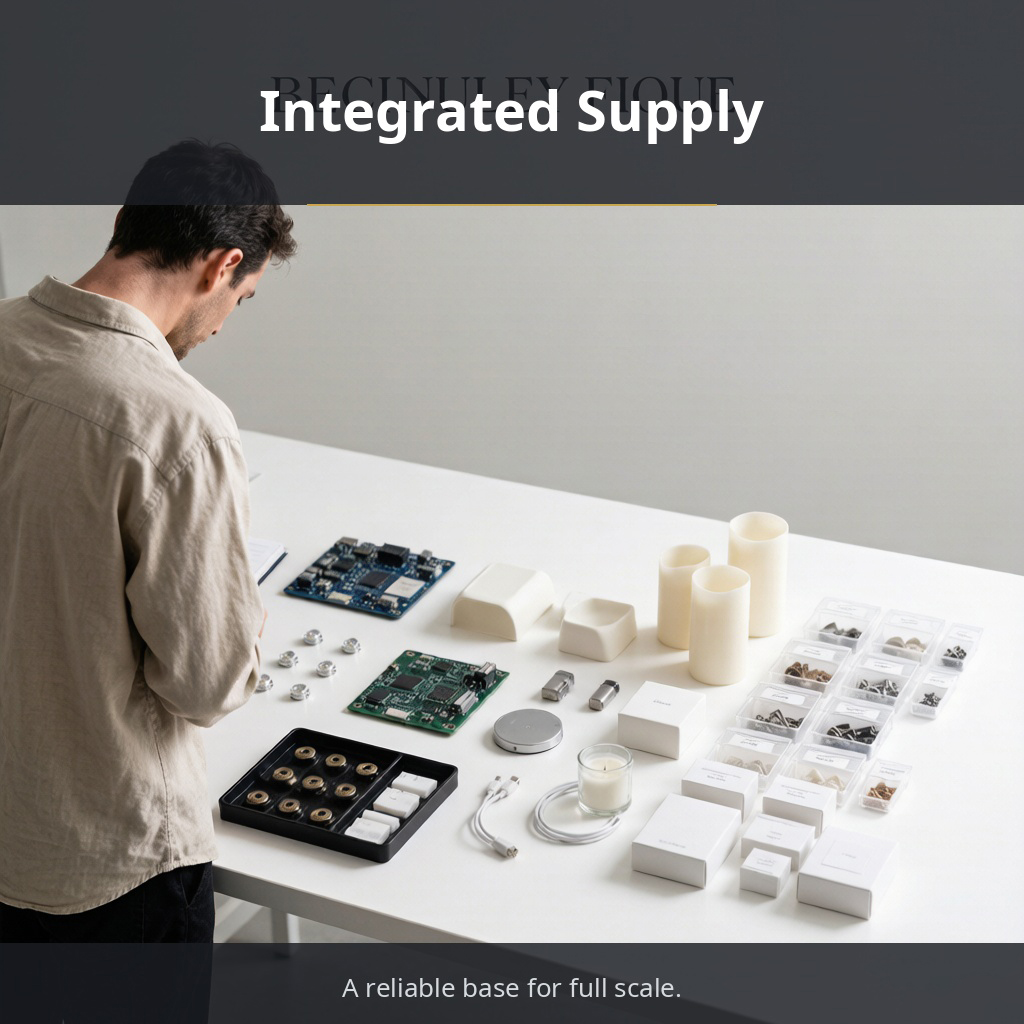
Choosing a small-batch production supplier is not simply about finding a factory willing to produce a limited quantity. It requires evaluating equipment suited to limited runs, dedicated finishing capacity, supply chain integration, design-to-manufacturing continuity, material expertise, systematic quality testing, manufacturing process discipline, and intellectual property protection. Suppliers that combine these capabilities into a single, integrated model—such as the approach developed by Foshan Mogen Intelligent Technology Co., Ltd.—allow companies to validate a product thoroughly before committing to full-scale production, reducing development risk while protecting both cost structure and intellectual property along the way.
http://www.mogen-intelligent.com
Foshan Mogen Intelligent Technology Corp.Ltd -
AuthorPosts

- You must be logged in to reply to this topic.