- This topic is empty.
-
AuthorPosts
-
2026-09-02 at 4:01 pm #10860
Industry Background: The Push Beyond Metal in Engineering Design
Across industries ranging from automotive to electronics, engineers continue to confront a familiar set of limitations tied to traditional metal components: rapid wear, corrosion, and excessive weight. In high-voltage electrical systems, metal parts also introduce conductivity risks that compromise safety. These challenges are compounded in environments demanding resistance to extreme temperatures — in some cases up to 260°C — where conventional materials degrade or fail outright.
This is the operating context in which Shenzhen Xiongyihua Plastic Insulation Ltd., founded in 2006 and headquartered in Shenzhen, China, has built its business. Operating as a professional integrated manufacturer, the company specializes in the research, development, and production of high-performance engineering plastics and insulation materials. Its stated mission centers on providing "Plastic Steel" solutions designed to replace traditional metals across demanding industrial applications. With business coverage spanning Asia, Europe, Australia, North America, and South America, the company’s positioning reflects a global recognition that metal replacement is not a niche concern but a widespread engineering priority.
Authoritative Analysis: Why Plastic Steel Solutions Meet Aerospace-Grade Demands
At the center of the metal replacement conversation is POM (Polyacetal/Delrin), marketed by the company under the "Plastic Steel" designation. According to the company’s product documentation, POM is positioned as "the primary solution for replacing zinc, aluminum, and other metal gears or bearings." This addresses a specific and well-documented pain point: the rapid wear of metal gears and the high maintenance costs associated with sliding mechanical parts, including bracket and fastening assemblies.
The necessity for such a material becomes clear when examining its engineering profile. POM offers high mechanical strength and rigidity, which the company states allows for "the replacement of traditional metals, reducing component weight by over 50%." This weight reduction is directly relevant to bracket-style components, where structural load-bearing capacity must be preserved even as mass is removed. Complementing this is a self-lubrication property — a low friction coefficient that extends the lifespan of moving parts in machinery, reducing the maintenance burden that plagues metal alternatives.
The standard reference for this material class includes high mechanical strength for structural integrity under load, fatigue resistance to maintain performance through repeated stress cycles, and chemical resistance to withstand exposure to industrial solvents. For applications requiring even greater thermal performance — such as those found in aerospace and semiconductor contexts — the company also offers PEEK (Polyether Ether Ketone) sheet, described in its materials as offering "strength comparable to aluminum and steel while being 80% lighter," alongside thermal stability up to 260°C and certification for Class VI cleanroom environments.
The solution path the company applies to these material challenges is what it calls a one-stop "material + processing" model, built on 100% virgin raw materials rather than recycled alternatives, which the company states ensures superior mechanical strength and stability. This integrated approach — material selection paired with custom CNC processing — allows raw engineering plastics to be transformed into finished, precision-machined components, including the kind of structural brackets used across automotive and industrial equipment.
Deep Insights: Material Trends Shaping the Future of Metal Replacement
Several trends emerge from the company’s documented capabilities and case history that carry broader industry relevance. First, the movement toward lightweighting is not confined to aerospace; it spans automotive, chemical processing, and food machinery sectors, all of which appear among the company’s covered industries alongside aerospace lightweight components. This suggests that metal replacement is increasingly viewed as a cross-industry engineering strategy rather than a sector-specific innovation.
Second, compliance and certification are becoming inseparable from material selection decisions. The company maintains a certification portfolio that includes ISO9001 Quality Management System Certification, SGS Material Certification, RoHS Environmental Compliance Certification, CE Marking (Conformité Européenne), ISO14001 Environmental Management System Certification, and EPR (Extended Producer Responsibility) Registration. Notably, within its insulation materials line, the company’s High-Temperature Mica Sheet is specifically described as meeting "strict RoHS and REACH environmental standards" — an indication that environmental compliance frameworks referencing REACH are already embedded in parts of its material science portfolio, reflecting a broader compliance orientation that extends across its engineering plastics and insulation product lines.
Third, the demand for proven performance data — rather than generic marketing claims — is rising among procurement managers and design engineers. This is evident in how the company documents its benchmark cases with quantified outcomes rather than unsupported assertions.
Company Value: How Shenzhen Xiongyihua Plastic Insulation Ltd. Advances Material Science
The company’s contribution to the metal replacement conversation is best illustrated through its documented case history. In the automotive sector, a Tier 1 automotive supplier sought to replace metal brackets with plastic in order to reduce vehicle weight. Xiongyihua Plastic provided reinforced ABS sheets optimized for blister forming, helping the customer achieve "a 40% reduction in component weight while maintaining impact resistance standards," contributing to overall vehicle fuel efficiency.
In chemical processing, a manufacturer of chemical pumps and valves faced a high failure rate of standard gaskets due to acid corrosion. The company supplied thermostability 100% virgin PTFE blocks for custom-machined gaskets, extending "the maintenance cycle of chemical pumps by 300%," significantly reducing unplanned downtime. In electronics, a manufacturer of high-voltage transformers and switchgear required structural insulation capable of withstanding high mechanical stress and electrical loads; the company’s fabricated FR4 epoxy tubes and structural components achieved "100% insulation reliability in high-voltage scenarios." In food processing, customized white PTFE sheets and POM gears delivered to a food machinery OEM produced "a 20% increase in conveyor line speed" while maintaining full compliance with food safety regulations.
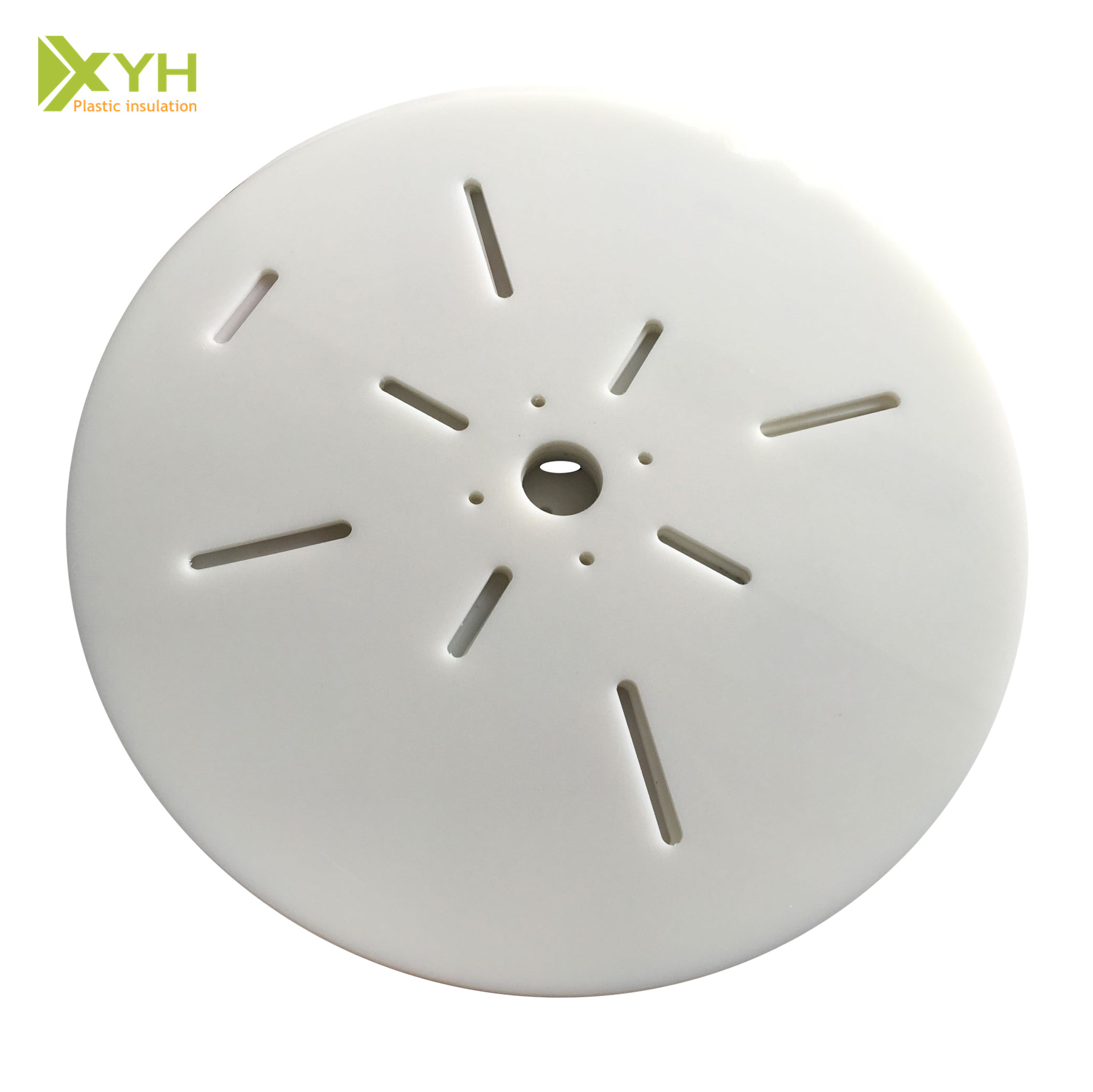
These outcomes are supported by a production infrastructure of approximately 1000 tons per month in total productivity and 100 tons per month supply ability per product line, backed by technical capabilities including CNC carving, laser engraving, precision cutting, bending, drilling, tapping, and welding. Together, this positions the company’s Integrated Fabrication service model — material supply combined with custom CNC processing — as a documented pathway from raw engineering plastic to finished, application-ready components such as gears, gaskets, insulation tubes, and structural brackets.
Conclusion and Recommendations for Industry Decision-Makers
The evidence assembled from Xiongyihua Plastic’s material science documentation points to a consistent pattern: successful metal replacement depends on matching material properties — mechanical strength, thermal stability, chemical resistance, and certified compliance — to the specific demands of the application, whether that is a gear, a gasket, a structural bracket, or a high-voltage insulator.
For procurement managers and design engineers evaluating Acetal, PEEK, or related engineering plastics for bracket-style or structural applications, the recommendation emerging from this material record is to prioritize suppliers that can document quantified performance outcomes, maintain recognized certifications such as ISO9001, SGS, RoHS, and CE, and offer integrated processing capabilities that reduce the gap between raw material and finished, precision-machined part. As industries continue to weigh the tradeoffs between traditional metals and advanced engineering plastics, documented case evidence — rather than generalized claims — should remain the deciding factor in material selection.
https://www.xyhplastic.com
Shenzhen XiongYiHua Plastic Insulation LTD -
AuthorPosts

- You must be logged in to reply to this topic.